Saturday, July 6, 2024

Whats that? More spirits?

I wrote a good chunk of these when the AC at my home broke and the house started to heat up. It was 91 degrees Fahrenheit (32-33 degrees Celsius) outside, which seemed to induce a feverish episode of creativity in me.

Hilariously, the least comprehensible of these was made after that issue got fixed. You'll know which one it is.

Content Warnings are: Discussions of hunting, very brief and indirect allusions to abuse in one entry, references to vocal dysphoria in that same entry, discussions of dissociation, and of course general discussions of cognitive disruption and drug use in ritual/magical contexts.

(Please do inform me if this requires any more warnings)


Great Hunters

Simple yet generally impressive spirits of both the natural world and the experiences of the Kith and Kin. They look as young adults dressed in little garb, painted in camouflage, though even a passing but close glance reveals the "paint" to be seemingly a natural part of their "flesh" and "hair".

They have aspects that combine various animalistic traits. Their eyes call to mind the slitted pupils of wildcats, the great gaze of owls and the all-encompassing eyes of dragonflies paradoxically all at once. Talon-claws spring from their fingertips. Their teeth are much like that of a cats, and their wings tend to either the insectoid or owl-like. Their noses are more akin to that of a dogs, though mystics and sorcerers both claim they can track better than the most perceptive of dog breeds. 

Regardless they dance through the wilderness in near-complete silence and near-complete invisibility. 

What they do is hunt. 

They stalk their game for a short time, and then, all at once they go for the kill. 

They are as efficient and quick as possible. Their prey suffers only for an instant. 

To the wild creatures, they extract nourishment and butcher them properly, keeping a small keepsake if the prey is truly mighty, notable or simply if they are sentimental.

They do hunt kith and kin, though rarely. If they do so, they do much the same as with wild creatures, but extract very little nourishment, and instead perform the proper death-rites for the individual.
The prey suffers very little, after all.

Many sorcerers would like to summon them, but are defeated by the requirements. One must hunt and butcher an animal in total silence, a notable one in some regard. Mighty or unusual.

A token must then be taken, and an offering must be made, and even then it is not guaranteed to succeed. If successful the Hunter will come to the conjuror, share a meal and inspect the token. If they are impressed they will allow themselves to be called via the token, for aid, companionship or invocation.

If invoked they offer either aid or the animal aspects and great skill with hunting, essentially allowing for the invoker to become a symphony of predatory perfection in much the same way as the Hunters themselves.

Other rituals made for conjuring or binding may be used, but the Hunters are wily and deft, and slip through bindings and weave around summoning like a wet fish slips from ones grasp. Great skill and precision is required to pin their essence and draw it to the mortal world, and even this may prove impossible for a skilled sorcerer.

Finally one may encounter them in moderate numbers in the rare great hunts they engage in, scattered among the seething throng of spirits that cavorts and revels through the long dark nights of the great hunt, dancing untouched at the epicenters of spiritual vortexes of the dead and death-dealing.

They stalk both the great wilderness-beyond-sight, the Deathly Lands and the twilit realms of cold rationality, though they favor the mortal world most of all.

It is possible that some of them were once Kith or Kin, but only murmurings and rumors of this are heard. Noting definite


Mountain Chief

A specific spirit, heavily associated with a specific mountain in a range. To the local tribes, it represents both life and death. Mercy and wrath.

It resembles, to those who see it, an enormous goat-creature. It possesses four great horns, two which twist upwards at a ninety degree angle to each other, and equidistant from the very top of its head, and two which are at ninety degree angles to the top ones, yet oriented downwards. Its beard, ears and "mane" create four more points between the four horns, generating a strange "octogram" star shape with its head.

This is emphasized by the shimmering thread that connects the horns. A strange thread that almost resembles the webs of spiders... Or elegant silken secretions of a particular form of worm. At each "groove" in the horns, the threading is affixed, so each pair of "adjacent" horns is connected by four threads.

Its fur is stone-grey, and it stands a full nine strides tall. More than four times the height of even rather tall Kin. Its face is a golden skull of a goat. Its eyes are burning spheres, like white-hot embers smoothed into pristine orbs. Its tail is, strangely, akin to that of an aurochs, a "flyswatter" tail with a long tuft of fur at the end for whipping at irritations. Irritations the spirit is exempt from by its nature.

Bizarrely the feet of the spirit are not the cloven hooves of a goat, but strange three-toed hooves. This detail, to those who are wise, betrays the ancientness of this spirit.

It is a celestial being. Its mountaintop is considered sacred, one of a few bridges between the worlds. A stand-in for the Axis Mundi. And so it is quite a potent spirit. It may choose to walk and not disturb the snow it stands on, or it may choose to prance on the very winds themselves, which are its own to command.

Invocations must be done at the mountain, preferably the very peak where the snows begin to fall. Noon or midnight is preferable, and equinoxes or solstices are ideal. Traditionally, a wooden bowl of offerings is placed in a makeshift altar of stones piled in such a way that the bowl may rest comfortably in the center.

The spirit may manifest if the offerings are great enough. If not it may still answer the invocation. In the later case, a sudden stillness of the air, followed by an impossible upwards gust of wind which carries the offerings into the air. The offerings then seem to vanish, like the spots in ones eyes after gazing at the sun.

The spirit is passive and much prefers to get mortals to act in its stead, rather than acting on its own. However it does have a tendency to fall into fascination (and, if rumors are to be believed, love) with particular mortals, whom it may show cryptically high favor. This is easy to lose, however, if one serves a spirit it particularly dislikes.

The spirit is said to offer a degree of authority over the wind, skills with weaving and textiles, a gaze that may stare into the deeper nature of things, skill with rearing particular worms and insects as livestock and the capacity to stride on wind alone. As with all spirits, other gifts may be possible.

Not all at once, of course. Not unless you are favored, or your offerings are particularly, shockingly, flattering.


Tap-Bugs

Though they may resemble insects prone to swarming, they are often conjured alone, or in small groups in uncommon cases.

They resemble great insects, as large as an adolescent if it were to stand up high and stretch out fully. However that is all that can be said of their resemblance to these animals.

They seem to be composed of metal, stone or natural glass, as if their sections were carved individually and they were somehow "assembled" into the animal form itself.

These are not drab greys or whites. The colors of the apparent materials they are made of are quite variable. Reds and yellows, greens and blues. Stones and gemstones and metals and glasses from numberless corners of the world, assembled into an articulate almost delicate insectoid beauty.

Visually they are quite stunning. Akin to a sculpture. Audibly, they are unusual indeed.

Their name is taken from their sounds. A series of constant sounds that overlap but line up in a bizarre fashion.

The quickest is a very delicate "tip tapping", like a delicate needle of metal against another needle. Every second it taps thrice. On every third tap, a deeper "dokk" of stone against metal occurs, simultaneously with the delicate tap. On every ninth tap and third "dokk" a deep "tong", deep enough to just barely feel in ones teeth is heard.

The sounds are, blessedly, not loud. Barely above a whisper. But they are constant.

They are, understandably, unpopular to conjure for long.

However, their invocations are very useful indeed.

Conjuring them requires one construct a vessel of several kinds of stone. It does not require impossible skill to carve, merely an honest effort to gather and use a wide variety of visually distinct materials. Assemblage is often done via drilling small holes in the sections, segments and limbs, and using threading to create the "joints."

The vessel, which should at least resemble an insect of some kind (beetles are popular due to the ease of construction, but others may work better due to the prevalence of beetle-vessels) must then be placed in an environment that has been rendered ritually sterile. A stone surface, swept of all detritus and repeatedly sterilized with various medicinal herbs is common, but it must be done carefully to avoid the accumulation of pungent aromas.

The tap-bugs will then inhabit the vessel, which will seem to deconstruct itself, pulling more material from behind and between the sections. These will click together, carve each other and then finally, assemble into the form itself, which will begin the constant sound.

They offer an incomparable sense of rhythm, an acute sense of measurement and geometry in both space and time, skills with sculpting and the capacity to harden ones flesh against blows, while retaining its pliability and flexibility. The last of which is often why they are summoned, but it is the gift they consider the most crude and least impressive.

They are much more likely to favor you if you seem highly cooperative with others, or conversely if you seem alienated by your ambitions and curiosity. This is the extent of their ethics, though they themselves are non-violent.


Oh cool the AC is fixed.

Echo-Masques

 These spirits are extremely closely associated with specific physical objects. To each spirit, a particular Mask, to each Mask, a particular spirit.

It begins with a sorcerer, or perhaps an artisan with such skill as to be near identical to sorcery. Regardless, they must weave the mask themself.

It must be woven of a material of extremely high quality, and so to must its structure derive from something exquisite. Flax and wood will not suffice. These are vain spirits and so must be coerced with fineries not easily accessible to forager cultures.

The mask must have structure and yet it must be flexible. It must be soft to wear. It must look exquisite. Gemstones and metal threading, ivory to hold its structure, glittering glass in the eyes.

At the crux of the conjuring, the mask must be given a voice. This is a difficult but deceptively simple sorcery to perform. All that is required is that one must truly give their voice to it. Fully, psychologically, abandon their voice and speech and give it to the thing being made.

One can learn to speak once again. Understanding has not been taken. Merely the habits and complexes that create a voice. They will never be able to speak with that voice again, but they can learn a new one.

Alternatively, it is possible to take a voice, via torments and cruelties that lead one to simply abandon it. This would suffice for the ritual, but there are ways for knowledge of such actions to spread voicelessly.

Regardless of the method, the result is the same. A Mask with a voice that has been given to it. It speaks as if from within the mask, and it quickly learns to understand what the words it now has mean.

The mask cannot at this point do much. It can talk, think and conspire, but little else.

It can be given more voices.

It can also learn to invent voices. It can learn to "throw" its voice, such that it seems to come from elsewhere. It can even, eventually, learn to take control of a dead, mindless or (if truly developed) living body.

With time they can even learn certain forms of purely vocal/verbal sorcery.

The purpose of such a thing is often a kind of ostentatious servant or entertainer. Singing comes naturally to them, of course, and they can learn to mimic all manner of sounds.

Rarely one is created as a scapegoat for someone who truly does not want their voice. In some cases, these individuals may form a partnership of sorts with the mask. A kind of mutualistic exchange of ideas and services. It would not be accurate to describe this in fully human terms, as the Masks are not and never were human, but a parallel can be drawn to the concept of "fondness".

Understandably, many of these masks go on to become notorious artifacts. There are a handful of such masks scattered around the world, though what auditory sorcery they have learned and the weight of ages may have... Changed them.


Formless Inquiry 

The name is somewhat inaccurate. The spirit does not merely lack form, it lacks true location and a significant amount of independent definition. Most of its essence lies outside of the range of perception and experience that defines the cosmology of Kith and Kin.

It is difficult to conjure such a being intentionally. They are more often encountered in an abstract sort of way, during a hallucinogenic trip that brings one to another realm. Rarely, such trips will bring one far, far outside of coherent experiences they understand. This is akin to a sort of dissociation from ones sensory environment, kinesthetic sense and even ones own thoughts and self.

Such an experience is unlike any of the psychedelic realms folded into the Mortal World as we understand them. They lie between these perceptions, or perhaps outside or underlying them.

It is "in" such perceptual not-spaces-nor-times that formless spirits dwell.

The Formless Inquiry is a particular kind of these spirits. Perhaps there is only one, or perhaps they are all completely distinct and it is more a pattern of behavior some of them follow. It is not certain to anyone which of these is true, but I find the later option to be the most convincing.

When a mind that has existed almost completely in a world of sharp sensation and perception touches these modalities, sometimes a resident... Thing develops something that might resemble curiosity.

And so it latches on, and follows the intrepid spirit-wanderer back.

The Inquiry does not resemble an entity in the traditional sense. Its more a complex of psycho-spiritual phenomena and processes. It may have elements that translate to sensation, perception, will, intention, compulsion or any other cognitive phenomena, but these express only the part of its nature that overlaps with the experiential reality that the spirit-wanderer understands.

It has elements that cannot be understood, that only exist to us by their wake-effects on those they latch to.

The Inquiry will then, from its lofty vantage point of a hapless spirit-wanderers cognition, begin to subtly twist and color their perceptions and experiences.

They cannot, or refuse to, overwhelm the will of the host. For whatever reason, they seem to avoid "touching" the awareness and will itself. Though the host will likely become aware that Something Analogous To Curious has slipped into their perception, via the "gaps" in their perception.

They are not malicious. This particular pattern of "behavior" is consistent in that regard. They are more like curious scientists or mystics, attempting to glean a world they can just barely catch the slightest glimpses of, via the aspects that they happen to share.

To most sorcerers, they are little more than a frustratingly persistent nuisance. They complicate trips to other realms, as they twist the experience and perception of the realms subtly, which is equivalent to a persistent side-wind blowing a ship just barely off course (or, sometimes, sending them so far afield that its hard to find ones way back) metaphorically speaking.

To a rare few however, they represent a possible mutuality. We are equally incomprehensible to these spirits. We are to them, incomprehensible spirits of things they cannot fathom, just as they are to us. An interplay can form, whereby one expresses an intention and the Inquiry responds in some way. In this way one can (excruciatingly slowly) learn to work with such a thing, to shape ones perception around some incomprehensible modality, and slowly understand what can be understood of it via its cognitive "wake."

And so a rare few mystics have a "partner" of sorts that is more akin to a condition, a cognitive disruption or a cluster of phenomenal processes. These are often the wisest, and possibly least coherent, mystics. Or at least the most curious of that which genuinely cannot be experienced or understood.

These mystics do seem to be the most skilled with simply... Entering a trip by will alone. Perhaps there is a connection, or perhaps some other sorcery is to blame.


(Next post is planned to be an actual rundown of the metaphysics and cosmology of Kith and Kin. Maybe that will make the above entry make sense. Probably not.)

Saturday, November 11, 2023

Kith and Kin: Character Creation (And Basic Mechanics)

 Hard, unbending mechanics are not the system I feel Kith and Kin should be represented in. Fully freeform isn't my favorite way to run a game, but FKR fits a certain level of comfortable flexibility for me.


Cueva De Las Manos, "Cave of the Hands" in Argentina.


Core Mechanic

If a player character or other acting thing within the world attempts something, consider whether it will automatically succeed or fail. I default to these to keep the game going. Sometimes I'll instead have the referee (so, me) roll for certain results, if they rely on things outside the players control.

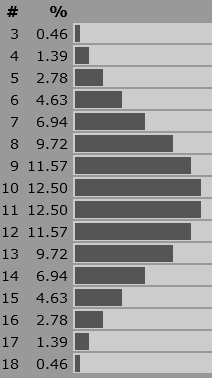
In cases of ambiguity, such as combat or other contests where participants and circumstances lead to difficult to predict outcomes, I prefer a 3d6 roll. It has almost the range of a d20 roll, with a rather nice bell curve that makes even small bonuses useful.

Thank you Anydice.

This roll is either attempting to meet or exceed a target number, or is against an opposed roll. I prefer the later, personally, it makes things more difficult to predict in these circumstances.

Modifications to this core mechanic are easy and possible. Tiny bonuses are okay, but I prefer biasing the rolls in other ways.

Specifically, advantageous traits and circumstances can allow you to roll additional dice in the pool, and drop the lowest number of dice equal to the additional ones. You can do the other way too, with disadvantages, just dropping the higher dice instead. This is described as giving one or more "dice" of advantage or disadvantage.

Advantages and disadvantages cancel each other out, to an extent, unless there's a reason for one of them to simply not apply. Then its not really an advantage or disadvantage.

This is used in character creation in other games sometimes. It pushes up the probability spread a bit. I like it, its rather basic and still leaves room for error (though unlikely the more dice you add).

For combat, I just take how much the attacker succeeded by, and whatever weapon they're using, and sort of eyeball how badly they hurt their target. Wounds are narrative, but can work as disadvantages too.

I also use "clocks" with "ticks" for things like bleeding out, disease, certain curses, etc. Smarter folks than I have explained those before. Again these aren't hard mechanics, more shorthands for my convenience than anything else.

This core mechanic is my default system for FKR games. Of course, if it gets to the point where you think someone would just succeed, or just fail, then just go with that and don't even roll.


By Ettore Mazza

Character Creation

First, select a people. This will provide some one dice advantages and disadvantages based on the group you select.

Some possibilities are

  • Youngfolk: Can use projectile weapons without a spear-thrower or sling thanks to having a waist. Higher self-control. Can switch rolls or skills faster than others. Look young. Tallest. Frail for their size.
  • Broadfolk: Tough and strong. Resist cold easier, more neutral on heat. Better visual perception. Require more food.
  • Smallfolk: Smaller. Require less food and drink. Can work together and get along with others easier. Weaker and more fragile.
  • Treefolk: Smaller, but less so than smallfolk. Can climb much easier. Using tools is a bit more difficult unless built by them (hands work a bit differently).
  • Elderfolk: Hodge-podge of benefits from other "Kin" groups depending on the Elderfolk. Either less specialized or hyper-specialized.
  • Wildfolk: Hard time speaking, but have fur. This makes you tougher, able to survive cold easier, but less endurance in heat. Easier time climbing. The more wild, the more primate-like, the harder it is for you to relate to the tools and behaviors of the Kin, the better "natural" traits you have.
  • Underkin: (Not done yet. I swear I'll make a post on them eventually. They deserve their own.)


Neanderthals with Modern Humans (By the Kennis Brothers)

Next, select what role your character played in their former society. This will provide some skills and potentially even some other advantages. Skills usually allow you to simply do things that others might have to roll for, and lets you roll in circumstances others might just fail. Other times they might provide a dice of advantage. Some possibilities are...

  • Craftsperson (provides skills in a handful of crafting disciplines. Can include cooking.)
  • Forager (everyone can forage, you're just really good at it. Includes fishing if bodies of water were in the area. Probably line or net fishing.)
  • Hunter (combat and tracking. Also includes fishing, though probably more spear-fishing.)
  • Wise-one (herbalism and spiritualism. An initiatory secret...)
  • Entertainer (song and dance, storytelling, Performance)
  • Leader (Keeping people calm and/or effective, Being heard, Making sense)
  • Farmer (Farmwork. Ideal conditions for plants and animals. Selective breeding. Less useful as a nomad.)

Others are possible. The bits in the parenthesis are meant to be skills you can have, and are more of a rough guide than anything concrete. Bit of a theme this post, it seems.

Some can be from more settled cultures, but will provide less useful advantages to surviving in the wild.


Looks-wise, these are somewhat-kin-adjacent Wildfolk. Behavior-wise,
it varies. Some are nice, some are not. Just like people. (From Primal, the show)


Next, select one (or more, depending on the ref. I'd require more disadvantages to take more than one) secondary quality to add some depth. This is like the role you had, but is less categorical. Some possibilities include...

  • Physically fit (Overall more athletic than your fellows.)
  • Iron Guts (Hard to poison or get drunk/inebriated. Resist venom.)
  • Ascetic (Need half as much food, drink and comfort. Just not as affected by their absence.)
  • Spiritual Affinity (Can more easily slip into altered states of consciousness. Useful for sorcery, spiritualism and mysticism. Might accidentally slip into them sometimes, especially if something is trying to catch your attention.)
  • Learned (More likely to just know things. Biased towards the culture you are from.)

Again, others can be possible. Work with your ref.


"Gabillou Sorcerer", I'm unsure how accurate
this interpretation is. Its cool regardless.


Finally, determine why you were exiled from your former culture. These are mixed advantages and disadvantages. Some possibilities include (but are not limited to)...

  • You made trouble. For whatever reason you simply were not compatible with the culture or authority of your former tribe. Sadly, you're prone to making trouble in other large groups too, but you're definitely good at stirring up peoples animosity towards leadership...
  • Sacrificial treatment. You were either selected for a sacrifice, or your banishment was the sacrifice. Either way, this weighs on you in some way. It might lead to preferential treatment by some unusual things though.
  • You were taken, not banished. In a raid or war, you were taken as a prisoner. You escaped. Fortunately, your old tribe would welcome you if you found them again. Unfortunately your former captors would also welcome you back if they found you again.
  • Endling. Your tribe was obliterated, somehow. This is unlikely to be your fault, but that might not be entirely the case, depending on the situation.
  • Forbidden Sorcery. Gain an initiatory Secret. If you were a Wise one, you may choose to gain another or deepen your understanding of your selected initiatory secret, or gain the favor of a forbidden spirit. The more powerful, the less attention and differential treatment you'd get. You might owe something.
  • Mutant. Some physical difference sets you apart from others. Real-world disability and disorders probably don't fit here, since there are entire tribes in which these differences are just a natural facet of that culture. Its probably something clearly unnatural. How did you get it? What is it?
  • Cursed. Highly variable. Perhaps you are a therianthrope, haunted by a spirit, or worse. Work with your Ref to determine how this works out.

Lastly, select one or two items/objects for each section up above. Food and drink for a few days as well as some tools are recommended. The groups should have at least a few weapons as well.

Your goals are survival... And whatever goals you make for yourselves, or develop naturally from your interactions with the environment and peoples.


Thursday, September 28, 2023

Kith and Kin: (Not) Extinct Animals and Domesticates

 For the blog carnival.

The themes anthropology and archeology, so why am I talking about animals?

Well... Animals feature in the cultures of people, because of course they do. Domestication and the like are all part of cultural body of knowledge.

Additionally non-domestic animals feature as elements of mythology and culture. This isn't always just "sacred animal" ideas, its sometimes quite complicated.

And in a world with things like animal spirits and other strangeness, there's gonna be ways that bleeds into the cultures. I mean, these already feature in real world cultures.

Anywho-

(i may update this with pictures later)

Archaic Humans

The most obvious, and most mentioned, extinct animals that are not extinct in Kith and Kin are people. You get to play these.

Summarizing them is difficult, after all the majority of people in the setting are archaic humans, and there's very little in the way of consistencies even within a species of people. However some notable things are...

  • Broadfolk tend to be less social than Youngfolk (homo sapiens). While Youngfolk have networked relations between bands and tribes, its even more severe with Broadfolk, since their groups are actually quite a bit lower (a few dozen at most). Of course, this can and does absolutely change based on environment. This trend tends to result in cultural deviation occurring more frequently.
    • This is actually realistic for them as people. Neanderthals and Denisovans seem to have lived in much smaller groups than Homo sapiens.
  • Smallfolk, conversely, are far more social than Youngfolk. Starting as islanders, but slowly spreading from there to coasts and more inland regions, Smallfolk learned to survive by emphasizing social bonds and collective identity. An individual Smallfolk is more at home with a group at the larger end of a Youngfolk group, and this would be considered moderate to small. Due to this, Smallfolk are among the first to have developed quasi-urban societies, and tend to vary less in terms of social drift from each other, but as always exceptions are common.
  • Treefolk, Wildfolk and the Kith are harder to summarize. The former two tend to lie between Broadfolk and Youngfolk, and the Kith cannot be summarized in any easy way.


Domesticates

Many forms of technology are much older in Kith and Kin than in the real world, while others are far off or regularly lost. Much domestication occurred in the real world between twelve thousand years ago, to just a few thousand years. The earliest firmly domesticated animals are dogs, roughly 13,000 years ago, but prior to that there is evidence of cohabitation.

Of course, this becomes a bit weirder in Kith and Kin. Though there is a common trend that animals with existing social structures will often be the ones to be domesticated.

  • Canines have been domesticated for a vast amount of time in Kith and Kin, given the pushed up timeline. I say canines rather than dogs or wolves because the extended timeline means that other social canines have long been domesticated too. This lends itself to a much greater variety in "dog breeds." The wild counterparts to these animals still exist, of course, but as a short list...
    • Wolves, the classic, lead to domestic canines as we understand them, which are effectively a subspecies of the Gray Wolf.
    • African Wild Dogs, as social canines that support the weaker members, already had an existing social structure Kith and Kin could interact with. Canines from this grouping are thus often more protective of their young, and of the young of others. There are, of course, morphological differences between them and canines familiar to us
    • Jackals, Coyotes, Dholes and other "Less social" canines are not fully domesticated, but uneasy truces are easier to form and maintain with them. They are at least, mostly, tame in regards to their behavior towards the Kith and Kin, but are not fully cooperative.
    • All of the above is mediated by the Dogpact, an ancient spiritual bond between the Kith and Kin and the Canine spirits whom act as the collective representatives of the Canines. This will be detailed later in this post.
  • Goats, Pigs, Sheep and Cattle are all potentially on their way to domestication, but maintain a degree of wildness that makes mass farming them impractical at best. They are hunted, fearfully avoided and rarely, worked with.
  • Felines as a whole maintain their aloof and predatory nature, but some smaller kinds have taken interest in the Kith and Kin. This cannot be said of some of the larger kinds. Its not wise to rely on the tameness of asocial predators. Its fortunate that for the most part they are more considered with actually filling meals.
    • Lions are not asocial, quite the opposite, but are not tamed nor domesticated. Most Kith and Kin would give them a wide berth, and vice versa.
  • Some plants have been selectively bred to provide nutrition, but mass scale agriculture is still rare, though not rare enough that most Kith and Kin have not at least heard of a "City." The eldest city is fed by the vastest collection of these domesticates.
  • Beyond this, mild and limited progress exists towards domestication of other animals and plants. Some corvids and other birds, however, have shown enough intellect to form a very different kind of relationship with the Kith and Kin. A diplomatic kind.


Beasts of Old

Extinct animals and plants yet live in the world of Kith and Kin. Some of these existed at the rough time that Kith and Kin is "set." However, the setting is intentionally anachronistic and so animals that never co-existed do so in this setting.

Think less "flintstones" and more "Avatar: The Last Airbender" but stone age and extinct animals occupy the role the hybrids do. Or perhaps "Primal." I cannot list all extinct beings that are in this setting, but a small taste is possible.

Note that when I say "Extinct" I mean extinct in our real world. Generally assume any extinct animal is somewhere in Kith and Kin.

  • Mammoths and Mastodons still walk the planet. Respected and revered by the cultures that rely on their meat for survival. There are spirits that resemble them, and their vitality and strength are revered.
  • Other Extinct Afrotherians cannot be summarized easily. Breaking tone for a moment, currently not extinct afrotherians also can't be summarized easily and I am kind of losing my mind over it. What do you mean the closest extant relatives of elephants that are not elephants are fucking manatees and dugongs? What do you mean the golden mole is more related to elephants than other moles?
    • Apologies. Additional Afrotherians in Kith and Kin include wolf-sized shrew-like predators, hippo-like trollish beings, bizarre relatives of elephants and giant manatees. I doubt that extant people would recognize their relation, but its certainly possible...
    • If so, then the Afrotherians might be seen as some sort of strange vast family of creatures. Canines and Felines all somewhat resemble each other, but the Afrotherians? Each is its own being. Seems like a fitting mythologization.
  • Extinct canines were bigger and less social. Borophagine, Amphicyon and more exist, and fill a niche somewhat akin to bears. Similarly, they are feared as bears are. Though these are, perhaps, a little bit faster.
  • Woolly Rhinos are revered similarly to Mammoths, with an additional "warlike" quality thanks to their aggression and near-blindness.
  • Cave Bears and other giant bears are revered as something between demons and petty gods in the northern regions they inhabit. Fortunately they're not extremely prone to hunting Kith or Kin, they're often much too small for that, but its unwise to trust a bear to not eat whats available to it.
  • Sivatherium, Paraceratherium and other mammalian giants are often revered similarly. In the places were Paraceratherium inhabits, its seen somewhat similarly to Mammoths or Elephants. Its names in these places often mean "Noble Giant" of some kind.

A small break before the next section. Non-Avian dinosaurs do exist in Kith and Kin, though they are rare in the regions I have focused on thus far. But, I would hesitate to call them rare overall. Kith and Kin is not a world limited by earthly geography, after all.

Reasonably, its hard to imagine what the perception of non-avian dinosaurs would be in the paleolithic world. But given the awe that is reasonably regularly afforded to existing giant animals, and the fear that existing, much smaller, predators are given...

Needless to say, the Kith and Kin find an odd sort of kinship with the mice and rats when these beasts make themselves known.

  • Raptors, even the smaller kind, are seen in a way that would remind one of big cats and avian raptors, perhaps being named for them even. The largest of them, Utahraptors and their kin, might have a degree of the cleverness that pop culture grants them, though not as extreme as might be thought. A feather from their tail would be seen as a noble trophy, certainly.
  • Ceratopsids might be seen as something similar in mind to a rhinoceros. Less blind, but perhaps no less aggressive. Less prone to intra-group conflict, perhaps.
  • Ankylosauria would resemble turtles, for a moment, before the crushing tail and superior size and speed are noticed. Still, a worthy hunt and a grand meal. But quite dangerous.
  • Stegosaurians have similar defenses, being closely related, but the spikes and plates would certainly be given significance as trophies or other objects of reverence.
  • Sauropods grew to sizes that, recent analysis suggests, might have rivaled the blue whales in weight. Hunting the largest of them is a non-option. They are groups of organisms vast enough to be landscapes. They might be revered, scavenged and followed perhaps, but not hunted.
  • Tyrannosaurids dwarfed all currently extant (and paleolithic) land predators. They were also likely not a "rushdown" group, more like tigers or sabre-tooth-cats. Fortunately they would probably ignore Kith and Kin alike, unless they threaten their brood. Humans could, theoretically, out-run them, but not by much and not forever.


Wednesday, August 23, 2023

A Magic System: Arcana (Secrets With Power)

I don't even know how you'd define this magic system. Its not quite freeform but its not quite limited either. Maybe "Diegetic Magic"? It definitely is a magic system that works with FKR games thats for sure.

The origins of this magic system lie in my enjoyment of the game "Noita" and its magic system. Its spells have properties that you can learn and exploit to ridiculous effect. The game is kinda about that.

However, while generic spells and modifiers work for Noita, Tabletop games require a bit more work. And so, after some time, this "Arcana" system was born.

The idea is to incentivize exploration and experimentation, and to make magic feel like something truly embedded in how the world works, rather than a game abstraction.

Making a potion can be easy, but it can also be like if chemistry really wanted to eat your soul. (Source)


Arcana

Arcana is anything that knowing about can grant some form of supernatural advantage. That isn't to say that knowledge of it is inherently powerful (conversely, thats not to say that knowledge of it isn't inherently powerful either), rather knowing about it opens up the capacity to interact with it or make use of it in some way.

Arcana can be anything, but as a list of examples they can be supernatural skills, languages, esoteric energies, otherworldly forces, groups of entities, anomalous mathematical principles, systems of logic, beliefs, states of consciousness, other realities, subtle aspects of this reality, gods, concepts, substances, processes, properties of otherwise natural things, psychological complexes, a series of specific actions, anomalies in how the world works, natural laws taken in bizarre directions and basically anything else you can imagine.

Arcana aren't spells. They're not rituals. They're not magic items. They're not (strictly) powers and they're definitely not a "class feature." They're meant to be the building blocks of these things, however (except for class features, maybe). Think about how during a ritual the magician calls upon various entities, draws magical circles, and more. Arcana are like these things rather than the ritual itself.

Whats important is that Arcana have properties and that these properties can potentially interact under the right circumstances. This doesn't mean you need to have a huge list of how different arcana interact, just that there needs to be at least consistency. If one arcana is an altered state that involves extreme self-awareness, and another is a psychic parasite, these can probably be used together in some fashion (perhaps as a way to control the parasite? It depends on how the two work exactly).

There's no hard categories of Arcana. Some are more broadly applicable, some are more useful in specific contexts, some are quite dangerous, some are relatively benign. The point is they can be theoretically anything that has supernatural properties that can be learned and made use of.

Some actual examples of Arcana might be

  • A species of psychic parasite, existing on a "Psychic" or perhaps "astral" layer of reality. They have specific things they feed on, byproducts, favorable environments and behaviors, all of which might be useful in some contexts.
  • The Astral Plane (And Astral Projection in general) and how it interacts with the world. Things probably can't physically step into the astral plane, it probably requires specific mental states.
  • An "otherworldly sense" that doesn't correspond to any of the major or minor senses known by science, but might be interpreted as "feeling" at a distance. It can probably be honed and trained to provide more information, and training synesthesia into it might have some interesting effects.
  • Clearly unnatural mathematics.
  • Any of these things really.
  • A set of beliefs that, when reinforced through ritual repetition of important aspects of the beliefs, can be treated as true by participants and temporarily enforced via certain methods.
  • Languages that let you speak to things that normally cannot understand or act.
  • A method of lucid dreaming that allows one to escape the confines of their dream and access others. Perhaps it can let you access a collective experience shaped by all dreamers, or perhaps things stranger even than this.

This could continue forever, but you get the idea. A true list would have more details and useful information, though some Arcana might be deceptively simple in their presentation.

Ideally as well this allows for competing or otherwise paradoxical magic systems to exist without rendering a setting completely incoherent. Entire perpendicular or parallel cosmologies could exist, separated only by the relative ignorance of those who have yet to discover a way the relevant Arcana bridge the gap.

Generally speaking the user of an Arcana should not know everything about it, and if a new one is discovered they should know just about nothing about it. The idea is to incentivize experimentation and discovery, after all.


God damn it I forgot to account for microcosmic-macrocosmic correspondence. (Source)

Applying Arcana

By this system, "Magic" isn't just one thing. Its not a single "energy" or "force" but rather the application of (typically multiple) Arcana to achieve an effect.

Lets run through a few examples of how this might go.

Taevalis, a practitioner of the Arts, prepares a silver pentacle engraved with specific sigils. They then place the pentacle in the center of a ritual chamber and begin to chant prayers and exaltation to the great one Vo-te-na-shu, a deific consciousness native to a realm of pure mind and logic (of which it itself is the primary component, akin to "space-time" for our own reality). Taevalis expertly enters an altered state of consciousness that allows their mind to cross the boundaries of realities, allowing the great one to use their mind as a channel of influence to our reality.

The sigils on the pentacle serve to communicate to the channeled aspect of Vo-te-na-shu that it is to reinforce the pentacle with its own psychic might, allowing it to serve as a protective object for the duration of the ritual. This works because Taevalis knows that the great one can understand the meaning of the sigils by way of its access to Taevalis' own mind and that Vo-te-na-shu is a perpetually curious being, which Taevalis is exploiting to orchestrate its willing participation in the ritual.

Taevalis then shifts their mental state slightly, and directs a degree of channeled entropic energy against the boundaries between their reality and one they have been studying for some time. The pentacle, due to geometric properties, the double-meaning of several of the sigils engraved on it and how silver interacts with the forces of the accessed reality, serves as a magnetic "net" for a being composed of illusion, flame and roaring sound from this reality. The ritual is successful, though there is a moment of uncertainty as the being strains against its bindings. Taevalis concludes the ritual by "imprinting" Vo-te-na-shu's power into the pentacle, exploiting how psychometry works to allow an "echo" of the power to remain without constantly channeling the great one.

At the conclusion of the ritual, Taevalis has successfully bound an otherworldly being to the object. Now they just have to figure out how to get it to do what they want, when they want it.

In the above example, the Arcana involved are Vo-te-na-shu, the state of consciousness that allows Taevalis to access other realties, the entropic energies utilized to break down the barriers between other realities (this might count as two, the entropic energies themselves and the barriers themselves), the other reality with its various inhabitants and the properties of Psychometric imprints left on objects.

The pentacle itself is a mundane tool. Its only by how this mundane tool interacts with the distinctly not-mundane elements that it gains its mystical importance. Without any of the Arcana involved, it would be a pretty trinket perhaps, but little more than that.

Modern doctor strange stuff has some cool (weird) stuff in it. Can't remember the exact issue this is from.

A second example, set somewhere (and when) very different.

Thalia and Zoe are two magicians who have been wanting to cooperate on a project for some time, but utilize very different sets of Arcana to accomplish things. However they have discovered a way to work together to further both of their knowledge of Arcana.

Thalia knows a specific method of lucid dreaming that allows her to wander metaphorical realms, and even into other realities via their more dream-aligned aspects, such as by entering the dreams of its inhabitants. Unfortunately she's not particularly capable of determining how dangerous it might be to access a given realm.

Zoe has a variety of psychic powers, developed through specific practices and disciplines geared towards developing such things. Most important to their goals are Telepathic and Extrasensory capabilities.

Thalia falls asleep while Zoe remains awake, using Telepathy to scan for when Thalia begins lucid dreaming. When she does so, Zoe telepathically weaves herself into the dream, effectively linking their minds and falling asleep as she does so, while remaining lucid.

Together they explore a variety of metaphorical landscapes over the night, using Zoes extrasensory abilities to determine if they should steer clear of a given location, experience, realm, mental construct and so forth. This is aided by Zoes moderate specialization into specifically "danger sense" ESP.

When they awake they quickly write down what they remember that they consider worthy of further investigation and experimentation. These include realms, locations, mindstates, entities, experiences and far more abstract things.

In this example, there's only two main arcana that are being used. The lucid dreaming method, and the psychic powers, but together they allow the two magicians to accomplish far more than they could individually.


Not every magical working is capable of succeeding, however. Which the next examples should demonstrate.

Nathan has downloaded a number of PDFs that, unfortunately for him, do contain genuine occult and Arcane information. He wants to perform a ritual to summon one of the Eye-Theives of Ovolomithia, a relatively small faction of otherworldly humanoids composed of layers upon layers of leathery tissue. They are known for stealing eyes, but also giving strange other eyes if they feel generous.

Unfortunately, Nathan has no knowledge of the Arcana that the writer of the PDF assumes the reader is familiar with, and is unable to truly perform the more abstract mental exercises involved in the ritual as a result, as well as having no ability to truly gather or shape the necessary energies involved. Nathan attempts to perform the ritual, and gets only a fascinatingly bizarre experience with psychoactive substances as a result.

The exact ritual isn't important in this context, just that the lack of understanding of the Arcana involved means that the ritual is, mystically speaking, not really doing anything. Granted such rituals might have a more mundane but profound effect on the participants, and there's always the vague chance that despite lacking knowledge one might accidentally tap into something real, but these are very distant possibilities. Akin to a one-in-billion chance.


However, knowledge of Arcana but an incomplete understanding of them can be far, far more disastrous than simply a ritual not working. Lets revisit Nathan at a later date...

Nathan now has a more genuine understanding of the Arcana involved in mystical practices, though he's not really done much to experiment with their limitations and interactions yet. This is unfortunate as he attempts to perform a ritual granting him passage through the All-Hallways, a bizarre realm consisting of hallways, backrooms, linked rooms and various other building interiors, all seemingly growing off of each other. The realm technically can lead anywhere, and this is an enticing possibility to Nathan.

The All-Halls is, unfortunately, fairly easy to access. Nathan prepares a closet door appropriately, by engraving the statement "To All Places" or its equivalent in several dozen languages, setting a resin that has been ritually prepared with energies associated with movement, otherworldly passage, space and time, and exploits an associative property of these energies to easily open a doorway to the All-Halls. Nathan has underestimated the All-Hallways, however, and does not realize just how confusing and disorienting of a realm it is.

Nathan enters the now-open passage to the realm and attempts to find his way to a door that leads into a hotel, somewhere, but the shifting halls and rooms over the next half-hour unsettle him. He attempts to find his way back to his entrance, but the pathways have closed off. Panicking, he tries to find a doorway that might lead somewhere familiar and accidentally falls down a flight of stairs, spraining his ankle.

He decides to leave through the closest doorway he can find, and emerges from an closet in an abandoned home, on the other side of the city he calls home. Thankfully, the All-Halls have some small measure of co-spatiality with reality, meaning that you're not likely to find yourself across the planet or in completely alien worlds with just a short stroll through it. Nathan, thankfully, did not encounter any other visitors of the All-Hallways, nor any of the deeper anomalies of the place.

In the above example, Nathan clearly understands the useful mechanisms of the various energies he treats the resin with, and demonstrates a creative use of their properties and associations between the phrase he engraved and the result he desired and how to exploit that to achieve it, but he did not have sufficient knowledge of the All-Hallways to usefully exploit them as a travel medium. He didn't know how to use what he got.

This is still an optimistic failure. If Nathan were to learn magical ways of finding directions to a goal, or found some way to influence or predict the nature of the shifting paths in the All-Halls, he could very easily render them into a useful medium.

Of course, not every failure is this much of a teaching moment. Some simply reach too far too soon, and find themselves at the mercy of forces they wished they understood better.

Some Arcana interact in clearly detrimental ways. If two classes of spirits hate each other, would you really want to invoke them in the same ritual? Probably only if you have some way to keep them from knowing about each other. What about mutually destructive energies? Forces which prohibit certain effects? Entities which you overestimated your capacity to bind and command?

Next post should be a list of more in-depth Arcana, and some more examples! Everyone loves examples, right?

Sunday, May 21, 2023

Some More Spirits

 People seem to like spirits, so have some more. Only four this time though. More to come later.

Still for Kith and Kin, though they can be adapted for elsewhere. At some point I want to make a system/setting that has a more Bartimaeus Sequence style of spirits, but for now I'm content with... Whatever you would call these.


Old Man of the Deep

He is not a spirit often called upon, for his dominion lies far deeper than any since the First Wanderers have dived. The true Depths are his home, and he learns much from the alien things that dwell there, whispering wisdom of a realm not meant for us.

His complexion is a result of apparently being carved from basalt stone. Or at least his skin is textured and just as tough as such, though it flexes and deforms just as skin and flesh would. Blades appear incapable of piercing him.

Striding along the horizon, one would be forgiven for mistaking him for an oceanic stone tower-island, distorted by heatwaves, reflected sunlight and exhausted delirium. Perhaps it would be easier to believe he exists, if such things were not required to summon him. He stands so tall that even the mighty longboats made to traverse the oceans are just barely longer than his extended arm. His rages are known to toss such boats horizons off course, or send them careening into the cliffsides, reduced to naught but splinters.

He has no hair. Instead great suckered tentacles grow from his scalp and face, writhing with his movements. They give the impression of wild and unkempt hair, each tentacle only the width of a mans arm, that nevertheless remain untangled, flowing in wind that does not exist.

Such tentacles grow only from his head. On his body, it is the growth of algae and kelp that give the impression of either great masses of fur or hair, or green clothing of a strange variety. Like an immense wildman of the deep.

He is not alone.

The depths that he has claimed are his, and he must display his authority somehow. To this end he has forged a pact with an ancient being of the depths, which manifests as strange horns, or perhaps a crown, of coral growing from his scalp.

They are as alive as he. You can see the giant (eye-sized) pale polyps dart in and out of their exoskeleton. They taste the currents, the air, the ether. They whisper things to him. He has gained a reputation as a seer. He knows that they might wish to manipulate him, though they seem individually simple, together they form a spirit far older than he is.

Invocations to him are scarce, but if successful he offers the wisdom of the deep. Be wary, however. This wisdom comes from a world built for beings much more ancient and vast than those that dwell upon the surface. The mind may be poisoned by such truths.


Effigy Receptacles

They are people. All the spirits thus far have no origins among the mortal folk, at least none that can be truly said to relate to us. These are different. They have bodies. They have villages. They have children.

They are dead.

Sometimes one must not let death be the end of the transmission of wisdom, and so steps must be taken to ensure that knowledge otherwise lost can be retained. Or perhaps a people have need for folk who will never tire through mortal action, never want for food or drink, never fear death and who will need only to repair themselves before they can move again.

Alas, these folk have no such strengths. Though they need no food, drink or sleep, they were still mortal once. They still feel the cold eyes of The First To Die upon their backs. His hand upon their shoulder.

They must sleep. When they do they return to His land. It is by his will that they are allowed to exist in this state at all.

The ritual is intensive. Traditionally, the excarnated skeleton of the deceased is laid out, and used as a scaffold to build the new body. Skin is woven of fabrics, flesh of dead grasses or furs. Hair of threads, or ropes, or whatever else that they might find appropriate. The final piece, before the ritual, is a mask of some make. Ideally one that portrays the character of the one who is to be returned.

Eventually a body is completed, and The First To Die is invoked with but a whisper. Something must then die by sacrifice, often an animal captured for such, but sometimes some unlucky folk is taken and given instead.

The false body stirs.

At first their attachment to this new false life is tenuous. They must be allowed to slake their thirst and hunger with the sacrifice, letting the fading life be captured by their receptacle to fuel their new existence. If the returned is not willing to, then it is here were things may first go wrong.

Perhaps once they were allowed to live among the living, but it has long been known that such things invite envy. The Returned envies the life of those who still live, those who live envy the robustness of the returned. All manner of tragedies and abominations have been unleashed, the actions leading to such things stoked by such feelings.

And so they live separately. In sacred places, or villages carefully and lovingly made for and by them, where they may converse with others like them and exist in comfort. Where they may act as if they live. They may visit their living Kith and Kin, but must not live alongside them.

Yet perhaps they need not act. Upon and within their bodies life stirs. Upon the brows of some, within their chests, within their skulls. Seeds sprout, flowers blossom, and the flaws with their new existence seem to give way to entirely novel experiences. The First To Die begins to call them less and less, begins to treat them like the living guests, and not like the resident dead.

What they are to become, none can say for certain. Death begets Life, just as Life begets Death.


Hearth-Heads

An elderly humanoid, often seemingly woven from still living wood, with hair (and sometimes fur) of moss and standing anywhere from a hands breadth tall to a height that makes their heads scrape the ceiling. Their name comes from the statues carved for their inhabitation, a wooden head depicting the head of the particular spirit inhabiting the home.

They are newer spirits, relatively speaking. Still ancient beyond comprehension to the mortals, but they only emerged with the first cultures that drew a distinction between "Home" and "Wilderness." They exist along this boundary, dwelling within the Proximal Space of the Home, yet carrying the Distal nature of the Wilderness with them. They are only one of many spirits of their sort, of course, and most common in the western regions of the northern continent.

Manners are important to them, but they are understanding and will explain the rules with an often off-putting intensity. Like a child explaining their current obsession. Hospitality is their main dominion and so they will respect guests to the homes they reside in, and expect to be respected in turn. Offending them is easy, but they are often willing to explain the nature of the offense, and are quick to forgive if action is taken to remedy it.

Depending upon the local culture, ownership of the home falls either to the current residents or the attendant heart spirit. In the former case, the Hearth-Heads may seem more frustrated. They feel as if the home belongs to them, but are unwilling to go against the local customs. Like many (though not all) spirits, they are beings of rules, following the conventions of society more than the conventions of physics.

Summoning them is relatively easy, though more difficult outside of the lands they typically reside. Carve a representation of their head, allowing your instincts to guide the creation of the details of the object. The final touch is, of course, placing it in an appropriate spot of respect in a home. They may deny the invitation if they suspect trickery.

The benefits are more domestic than some may wish. As a guest, they will aid with the cleaning of the home, but only when none within the home may witness them doing so. They cannot always tell if someone is asleep, of course, so some may catch them by surprise.

Particularly respectful or kind homes may receive gifts, though they may seem like mere toys at a careless glance. These gifts often have spiritual properties, which may become apparent with time (or with sufficient insight into such matters). Discarding them is a grave offense, of course, but gifting them to another is far from such, and may even win greater favor from them.


The First To Die

He was born to rule the world.

It was his birthright, as the first being to be born. Alas, there was no world to rule, so he gave his life in sacrifice. From his body, the world and its inhabitants were forged.

As the first to die, he went where all who perish go. There. The Hereafter. Or perhaps it did not exist before he perished. Before him nothing had died, so perhaps he impressed his divine mind upon the fabric of the All and forged another world from his very spirit.

And so that world is his by deathright.

He stands thrice as tall as any observer, with great black vulture wings each thrice as long as he is tall. An immense Crown of Horns emerges from his crown and scalp. He wears nothing but a simple wrap-around skirt, or loincloth, for modesty. He is at once beautiful and horrifying. An Androgyne of unsurpassed beauty and vitality, and a ragged rotten corpse empty of all, and a mummified prince of the highest authority, and a sheer incomprehensible shadow over all of creation, and all the memories of all that have ever died and will ever die acting as one.

All at once. It is utterly maddening to be in his presence without some form of coping mechanism. He is no mere "greater spirit" but a fact of the world. A facet of the incomprehensible entity that is Everything. The stories presented thus far are merely one cultures understanding of what he is. He may manifest in other, stranger, or more familiar ways. Paradoxically all at once, oftentimes.

Those who die venture forth into his realm, his kingdom. Slowly they grow closer to him. Eventually, they are indistinguishable from him.

And then, they are reborn. He is no jailer. A King, certainly, but not a tyrant.

Those who remain in his kingdom longer than most are often those cursed beyond death, who escape to wander the living world at the first opportunity. Such beings are the origin of the Blood Drinkers, the Flesh Eaters, the Ghosts and more.

Not all who remain in his kingdom beyond death for long are cursed or afraid. Some remain to guide the next generations, staving off their rejuvenating metempsychosis for their sake.

The First To Die allows it, and so it may happen. It is unknown if he can truly be resisted, or if his factual nature is more akin to the flow of a river, that one can go against... Or perhaps sidestep completely?

Saturday, April 29, 2023

Some Sapient Aliens

 The Flourishing Void is my own take on "optimistic sci fi." I'm going for mostly hard sci fi with a few "big lies." Maybe I'll make a post about that sooner or later.

These are basically citizens of the Galactic Community, with some effort you can sort of squeeze yourself into the right mental states to understand their own instincts and point of view, and they can for you. There's aliens that are much weirder than this, but this post is long enough as it is.

For all of these I have yet to put significant thought into the actual biochemistry of them, though that's definitely something I plan to do in the future. So expect possible changes to any references to fun biochemical weirdness. Crustaceomorphs are kinda the exception cuz its part of their thing that they're biochemically compatible with earths biosphere, in a case of sheer cosmic coincidence.

Also included is their perception of humans, explored through some metaphor.


Chuuls from D&D look like scrawny, monochromatic
Crustaceomorphs with too few limbs.

1. Crustaceomorphs

Nicknamed "humanities twin" despite their considerable number of differences. This is because they were the first higher lifeforms humanity actually managed to contact, and due to sheer cosmic coincidence were at essentially around the same capabilities, technology-wise. Further similarities exist. They essentially filled the niche of "social troop-forming organisms descended from tree-analog dwellers" leading to similar baseline instincts. Shockingly the majority of their biospheres biochemistry is actually compatible with earths, though "cross-contamination" is still of little concern due to subtle differences that mostly impact pathogen development.

The cooperation between both Homo Sapiens and Crustaceomorphs was swift following first contact. While both were willing to cooperate and communicate, they did not have any way to know if other species would. Though these fears proved to be mostly unfounded, this initial goodwill proved well-placed for both species, as most polities involving one almost inevitably involve the other in the modern day.

While cultural details could continue from here, there is only limited space on the internet to put entries, and the Crustaceomorphs have a cultural landscape every bit as rich and diverse as humanities and all other species in this list, and yet completely distinct from them.

Physiologically they are quadrupedal, possessing two additional limbs for fine manipulation, and two more "pincer" limbs for when force and strength are necessary. The "head" structure contains sensory organs, including a number of "feelers" that engage in somatosensory and chemoreceptive roles. Their exoskeleton consists of several layers, the outermost being formed of chitin and the inner layers giving way to calcified tissues akin to human bone. Internal musculature is ring-shaped, and can both push and pull with the same muscular structures, leading to an organism overall more robust and strong than their human companions.

Perception of Humans: Soft, fragile, weak and impossibly graceful. Like a person between molts, but even more so. Faster too, though stamina falls within normal range. They are singing by default, when they try to speak your language (what of it they can speak) it sounds painful for them, though they try so very hard. They seem like they should fall over the moment they try to move, and for a moment you think they are falling and your hearts skip a beat, but then they land perfectly and are already on to the next fall.


Anosteous Sapiens are like if Sea pigs were also elephants, snails and trees. 

2. Anosteous Sapiens

At first glance the name "wise boneless ones" brings to mind organisms like the Octopus or Slug, but incredibly intelligent, a staple trope of Sci Fi. The Anosteous Sapiens, however, are far less "amorphous" and "wet" than these organisms, as tough structures within their biology are formed via cells that possess analogs to "cell walls" rather than via typical biomineralization. This is a feature of many ambulatory organisms of their biosphere, as for a significant portion of its early history, typical minerals useful for the biomineralization process were nearly totally absent from the biosphere, only entering during subsequent collisions with minor celestial bodies.

This means that most hard tissues in their body are actually composed of cellular structures. An example consequence of this is most organisms are able to regrow and/or heal teeth and claw analogs without worrying about needing to regularly "file them down" so to speak.

Physiologically, they resemble something akin to a three meter long, meter tall opaque and skeleton-bearing analog to the "sea pig", possessing a large cephalothorax as their primary bodily mass, with ten blunt "legs" for movement. Internal musculature allows them to move fairly swiftly for their size, but still slower than a more gracile organism would be capable of.

Eight sensory tendrils closer to the top of the head, resembling eyestalks of snails but including chemoreceptive and audio receptive organs, allow them to percieve a 360 field of view and lend themselves to audio-spatial sensing as well. Twelve manipulator tendrils tipped with a dexterous "cup" akin to the trunks of proboscideans, line the "mouth" of the organism. Finally, four radula are are contained within the "mouth" for grinding and processing food. The numbers provided only reflect an average, as approximately ~30% of their population possesses an unusual number of these organs, and of these ~83% possess more than the standard number, seemingly a bias that was selected for historically.

Their niche could be described as "herd scavenger-grazers." Historically living in herds of hundreds to thousands, with a fairly clear competitive hierarchy, one would expect their societies to trend towards hierarchical despotism, and this does seem to be the case throughout history. However, modern Anosteous polities trend towards a more collectivist bias, forming large migratory communities. This has occurred following a relatively unstable period in their political landscapes, which led to a disillusionment with existing structures.

Perception of Humans: Like if a small and thin tree with too few branches was a person, faster than you, and moved around by acrobatics all the time. Weirdly inflexible digits on the upper manipulator limbs, and a weird inflexible orifice for feeding. Restless, like someone high on a stimulant. Their eyes flick around like they can't focus on one thing at a time, like to get the full picture of what's going on they need small snapshots every few seconds. Their voices are choppy, though some of their languages are a bit more (or less) so. This makes them seem almost like they're constantly ending their statement, and then beginning it again. Despite this they're just as thoughtful as anyone else, they see their experience as seamless and it gives interesting insights.


Coral Hives are called that for a reason. Much of their population is sessile support structures
that look a bit like corals or barnacles. Mobile workers vary in appearance too.

3. Coral Hives

Eusocial organisms with a complex life cycle, consisting of sessile and mobile morphs and colonies that differentiate based on chemical and genetic signals, as well as possessing eusocial caste differentiation. One of the most alien species that still acts as standard citizens of the Galactic Community, though the vast majority of their species is not sapient.

The sheer complexity of their life cycle is astounding, but the basic "larval" form is a radially symmetrical organism with a central "lobe" of sorts, the whole organism being roughly a fingernail in size, though eventually reaching up to a fist in size. Bilateral symmetry is sometimes introduced later, in addition to greater sizes depending on the caste.

The typical "Citizen" of this species is one of the sessile "Queen" morphs and their support-colony, ironically acting as both a controller and a reproductive caste, in contradiction to the standard earthly eusocial norms. Per Galactic Community standards, the non-sapient members of the hive, as well as its sessile structure, are considered extensions of the Queen, and extracting them from this is seen as morally equivalent to extracting a brain and placing it in a support structure bereft of the ability to manipulate the environment.

The "Queens" resemble a half meter tall "barnacle" of sorts, with feeding and reproductive orifices dotting the base, and a series of sensory and command structures extending from the top, like a tree of sorts. These "topmost" structures are modified limbs and sensory structures, the process of metamorphosis is quite extensive.

Queens command drones via pheromones, electroreception, photon and sonic signals, and may have other means as well. The sheer complexity of their communication and life cycle, as previously mentioned, has led to many theories regarding the "Coral Hives", further spurred on by the extensive ruins in the regions near the center of their space, including their own home-world. Some of these theories include that they are of artificial origin, though evidence of this is sparse to nonexistent.

Coral Hive culture is exotic, even by the rather broad standards of the modern day. To them, other species seem as if they are hyper-developed sub-units that have grown into fully fledged people, so the feeling is somewhat mutual. Though not a common sight by any stretch (their "nomad" population consists of a bafflingly small few hundred billion), they remain a staunch member of the Galactic Community, their "nomad" population often serving as valuable members of a crew, their hives being able to use their smaller units to get into very small spaces for repair and surveillance. Their more habitat and planet bound populations often aid with construction and repair in a similar capacity.

Perception of Humans: An entire species of disabled queens, who all act as each others workers and create technology to act as prosthetics. They are so bereft of basic capabilities that they need entire prosthetic clonal worker complexes (buildings and vehicles) to do basic tasks. They are almost insensate, struggle to make even the most basic concepts understandable to each other, lacking every capability that a worker morph could provide. And yet they work together in ways that we struggle to. Each one of them is a queen and a worker of each other. We could learn something from that.


Vitaegel anatomy is biochemistry. Its kinda like this, but uses
different shapes, because its not earthly life. Source.

4. Vitaegel

Multicellular life is not the only path towards complexity and, ultimately, awareness. Some life takes a different path. Slime Molds on earth are an amalgamation of countless individual amoebic organisms that have merged into one enormous cell for the purposes of movement, nutrient acquisition and overall protection.

The Vitaegel are similar, though distinct in a great number of ways. For one, they are not the merged forms of amoebic lifeforms, but rather similar to multicellular life in the sense that they reproduce, gestate and develop complexity in similar fashions.

The basic structure of the Vitaegel is a gelatinous substance, fluids contained in networks of complex chemical chains. Suspended within this gel are organelles of varying size and complexity, by default distributed throughout the organism. This includes stores of genetic information. The entire structure is often enclosed by a tough outer membrane and threaded with a complex immune system. They vary in shape more than humans vary in skin tone, eye color and hair color combinations, leading to their alternative name: Polymorphs. This is also due to their ability to redistribute organelle distribution and directly command very baseline levels of their biochemistry.

Evolutionarily, the planet Vitaegel are native to is unusual. Multicellular life seems to have been repeatedly out-competed by more bizarre alternatives. In fact its unclear if Vitaegel are even a distinct species when compared to the flora and fauna of their homeworld.

The "brains" of Vitaegel are organelle complexes that utilize altered genetic material as a medium to store information. These complexes consist of several layers, the outer sphere being simply to isolate the sensitive structures, the middle membranes are responsible for much of the complex activity around producing, manipulating and packaging and ultimately transmitting the gene-synapses, and the central structure itself. This central structure consists of the aforementioned former genetic material.

Communication is achieved via packaging these "genetic" structures in a packet of sorts, redundantly so as to avoid the potential for miscommunication, and then physically exchanging it with another. In some sense, talking is mating to the Vitaegel, as they can use the communicated information to make alterations to their biochemistry.

Vitaegel were actually contacted prior to achieving spaceflight, due to a series of mishaps leading to the realization that their planet was inhabited. They have rapidly become a fixture of much of the local galactic community, their adaptability and reproductive rate is beyond compare after all.

Perception of Humans: Weirdly inflexible clonal colonies of extraordinarily specialized individual lifeforms. Thoughts do not arise normally, instead arising from the simple communication of billions of individual lifeforms. They communicate abstractly, using wave-patterns of various kinds to make information known. The concepts communicated are simple, but act as "keys" to complex abstract objects. Essentially just another alien. 


Pictured: Intolerably cold conditions for a Lithomorphic lifeform.

5. Lithomorph-48

Deep in the mantle and outer core of terrestrial worlds, it is possible for obscure chemistries to take place. The variety of these that can occur is beyond the ability of any one person to list, but the most relevant are the complex irregular crystalline structures that form in particularly chemically diverse worlds.

These crystals, at the basic level, can perform specific processes. They are naturally occurring machines, powered by local heat gradients, exotic chemical reactions, kinetic energy and electromagnetic phenomena generated by the planetary core. These machines, in many places, have formed dense clusters which eventually achieved homeostasis, and self-replication. Cellular life of sorts. Abiogenesis, in a completely alien environment.

Life has many challenges as it reaches to the stars, if it ever seeks to. It must ensure that its units survive in the hostile environment of space. It must ensure that they can resist the gravitational pull of the celestial body they develop on. It must ensure that they do not perish in the return trip.

Though equally (perhaps more) common than carbon-based life, lithomorphic life has many many more challenges. The heat and pressure requirements for them to survive are extraordinary, the alloys required to maintain such things are exotic even by their own standards. All of this, and they must have the desire to reach for the stars, and some way to get through the tough, cold upper mantle and life-consuming cold of the crust.

Lithomorph-48 won the cosmic lottery in this regard. Their proximity to their star scoured the atmosphere of their planet and rendered its surface molten. The regular solar flares deposited enough materials to maintain the planets mass, even as it might have otherwise very slowly fallen apart under the intense conditions. This contributed to a regular influx of exotic elements deposited at the surface, encouraging experimentation.

Physiologically, it is difficult to describe Lithomorph-48. Their shape might not be too out of place in an oceanic abyss, a meter long "trunk" that branches into multiple "arms" on one end, with a "bell" of sorts for moving through their medium. Their technology is mostly their equivalent of "biotechnology", taking advantage of their naturally evolved chemically flexible "glands" to grow technologies that aid them. These "glands" seem to have originated as a number of individual synthesis zones for the rapid production of important biochemicals that were favored as they slowly underwent a progressive development.

Early Lithomorph-48 space programs involved chemically induced and focused "supervolcanic eruptions" that launched strange ships into the void. These ships were composed of extremely dense and heat-retaining metal alloys and metamaterials, a requirement for them to even consider going to space. These bizarre contraptions (that would resemble a jet-black chrysalis of some monstrous butterfly to a human observer) kept their interiors within acceptable temperature and pressure ranges, though the residing lithomorphs had to enter their "slow" state to do so. Modern ships resemble these older ones, but the material composition is far more exotic, far more efficient and propulsion is achieved via reactionless drives (as is standard).

Settling and terraforming planets is rare in the Flourishing Void. Life-supporting planets are usually observed from afar, or closely in a controlled manner when more exacting science is desired/required. In the rare cases where a planet is settled (usually a lifeless one with surface or sub-surface habitats) then Lithomorph-48 volunteers will often begin to settle its deep interior, working with the surface world in symbiosis.

Perception of Humans: Extremophiles of the highest order, living far beyond where all life should be rendered impossible, composed of strange chemistries that can only operate at all-consuming life-obliterating cold. Not even twice the total length and volume of one of us, but over ten times as diffuse. Their senses turn to the void and they can impossibly percieve other celestial bodies, other stars, without instruments of interpretation. If they entered our habitats, they would collapse into only so much exotic chemistry. They are strange, delicate, diffuse, alien and beautiful, drifting at the edge of possibility.