Showing posts with label mechanics. Show all posts

Thursday, January 9, 2025

Kith and Kin: Core Mechanics Redux


Second post that is an adapted PDF of my stone age game. None of this is fully prescriptive, especially the action resolution mechanic. Thats just my preferred


Core Mechanics


Action Resolution 

Under most circumstances you will not have to make a roll to perform an action. The GM (Genius Mundi, World-Soul) will rely on their understanding of how the world functions, your characters positive and negative traits to determine if you succeed or not.

However there are cases where there is an ambiguity in if success or failure is what would occur especially in person to person, or entity to entity circumstances.
In these circumstances roll 3d6.

If against another entity or active situation, then it also rolls a 3d6, possibly with advantages and disadvantages.

If against some passive object or circumstance (such as attempting to leap a gap), then this is rolled against a target number. If that number is exceeded, then it is a success, possibly with some additional benefit. If the target number exceeds the result, then it is a failure. If they exactly match, then a partial success, partial failure or some other ambiguous result may be the outcome.

In some cases multiple numbers can correspond to “matching”. In this case the target number is represented as a range of values, such as “9-12”. This means anything from 9-12 is a “match value.” This is usually the case for results with “degrees” of success. A 9-12 on foraging might bring an okay amount of food, but a 13 or higher will bring more.

If you have traits or skills that contribute to the action and they do not ensure success or simply allow the roll to occur at all, then you may gain dice of advantage.

This is represented by rolling additional dice, but only taking the highest 3 as your result. This biases the outcome by an increasing amount for each dice of advantage.

Disadvantage works the same, but you take the lowest three. Advantage and disadvantage cancel out, so if you have 2 dice of disadvantage and 3 of advantage, it is treated as you having only one dice of advantage.

Generally if you would have more than three dice of advantage that is probably a good sign you should simply succeed.

Similarly for disadvantage, more than three dice indicates the check should probably just be an automatic failure.

There are some cases where that might not be so, however, such as when two entities have significant advantage.

If the GM allows it, successes that have two results of six counted may be a greater success, and three even greater. Rolling higher than something by a certain multiple (i.e. rolling two or three times higher than required) may provide greater advantage.

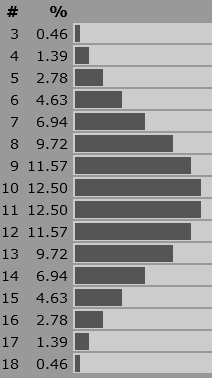
If not using a target number, then range values can be used. Im fond of the following table, basically using the attribute bonus ranges from AD&D as a guide.

  • 3: Worst result.
  • 4-5: Worse result.
  • 6-8: Bad result.
  • 9-12: Average result.
  • 13-15: Good result.
  • 16-17: Better result.
  • 18: Best result.

With context clarifying what qualifies under each range. "Average result" on foraging in a rain-forest might net decent amounts of food (result-8 meals worth perhaps?) while the same thing in a desert wont give anything. I use this as a guide for passive difficulty.

Any other modification to the action resolution system is not the baseline game, and is reflective of unique circumstances in the game world. Some things may flatly raise the size or amount of dice you roll in some circumstances, and some entities might be mighty enough to warrant such changes to their rolls. 

You may become one such entity, with time. 


Resource Management

Resource management can be difficult in some tabletop games. Thankfully, you are playing a game set in the ambiguously paleo-meso-neolithic era and will not be carrying around a backpack with 2 metric tonnes of resources.

Carrying resources is useful, and sometimes you will want to stockpile. For the most part however, you can forage for resources.

Fishing and hunting are similar.

You likely won't be able to stockpile massive amounts of resources, both due to spoilage and your mobile nature. Carrying around a week's worth of firewood is a Sisyphean effort.

Even so, certain skills will let you preserve certain resources (dried and salted/treated food for example). You will have limits to the amount you can carry and certain circumstances can cause spoilage (don't get the dried food wet unless you plan to spend time drying it after).

For every two kilos an animal weighs, you can gain one “meal” of food from it. Foraging and fishing will also bring in food, depending on the area. The less vegetation, the more you’ll have to rely on hunting, and vice versa. 


Resources

The actual resources you will need to keep track of are

  • Useful Food (Each character needs at least a meal per day or they start to become hungry. Two meals a day will slowly reverse the effects of hunger, but some starvation ailments will be “permanent” until you can fully recover over time.)
  • Fresh Water (Each character needs two proper full drinks per day or they start to dehydrate. One full proper drink a day will give small maluses but wont kill you.)
  • Firewood (Indicated in hours of fire time. The more you put on the brighter it will burn, but this can burn through them faster.)
  • Artisan Materials (clay, hide, fabric, fibers, adhesive, wood, flint, stone, bone etc)
  • Medicinal Substances (Measured by effective dosage)
  • Psychoactive substances (Measured by effective dosage. Minimal, Low, Powerful, Heroic and Extreme, for hallucinogens.)
  • This is about every relevant resource, but others might be possible. Trade goods? Shiny stuff?


Time Management

There are four primary temporal scopes of play. The Gm keeps track of the moon (month), time of day, day in the moon, phase of the moon, season, time of day, and so on.

  • Frantic Time: When something happens that requires immediate action. Time is measured in “rounds” (~3-6 second intervals). Characters can generally take two actions (movement, attacking, defending, whatever). This is combat, chases, etc.
  • Exploration Time: When PCs are taking their time to explore an area, figure out what is around, forage, fish, and so on time is measured in “Exploration turns” of roughly 10 minutes. Thus, “Exploration actions” (like foraging) take more time to bear fruit (often literally).
  • Travel Time: When PCs are traveling long (ish) distances, time is measured in “Hours” or “Travel Rounds”. Each hour there is a chance of something happening, a chance to recheck directions, and so on. These can be interrupted (something can happen in the middle, they can choose to explore a local area), but this is the rough idea.
  • Downtime: Perhaps the PCs are choosing to prepare long term for something. To stockpile food, to spend a large time foraging to accrue large amounts of food. During downtime, time is measured in suns (days, 24 hours), moons (months, 30 suns), seasons (3-6 months depending on the environment) and cycles (years 12 months).

Note that years are measured as 12 months of 30 days, giving 360 days to a year. This is only notable in that the life expectancy of beings is a few more years over the course of a human lifespan, though is still the same amount of time. This is just to make sure natural cycles are a little bit easier to keep track of on the GM side.


Travel

Space and location is represented in “Zones”.

Zones are not biomes or biotypes. One forest will be split into multiple zones.
The exact spatial dimensions of the zones are not totally set in stone, but “Horizons” is the general measurement at this scale (roughly three miles or 4.8 kilometers in a given direction, the rough distance a horizon is away from an average observer on flat land, making a horizon six miles, ~9.6 kilometers, across).

Rather, the size and the difficulty of the zone is represented by “Travel time” and rough dimensions given in “Horizons”. Remember the average human walking speed is about 4.8 kilometers an hour, and a bit faster based on health. Terrain of course influences this.

Zones can have multiple points of interest scattered throughout them. These almost always have consistent locations. Distance between these points of interest is given in horizons, though characters can wander between them and find other points of interest.


Combat 

3d6 attack vs 3d6 evasion, blocking/parrying, etc. with modifications as described under action resolution.

Failure is a failure of the attack to connect, due to having been dodged, blocked, whatever.

A tie is that some consequence happens to both, a success in exchange for small consequence determined by the foe or they succeed with some complication described by you. Really depends.

A success is a hit. Damage is whatever a “hit” is for whatever weapon you use, and is descriptive. The defender gets to choose where they were hit.

Twice or more the defender's roll is a direct hit. Either you get to choose where or the defender chooses and the damage is even worse.

Thrice or more the defenders roll is a critical hit. Essentially both options of a direct hit happen, with increased effect the greater the difference.

The actual severity of the damage depends on the weapon and the defender. If it has a tough enough hide, a character of average strength may not be able to harm it (unless they strike a weak point, such as in the mouth).

Where and how you can hit depends on the weapon. Slashing and bludgeoning weapons struggle to target small weak points or exploit them. 


Damage and other Terrible Things

Damage, Illness, hunger, thirst, sleep deprivation and so on are all treated as localized status effects. They are descriptive, and their effects are based on eyeballing a real world-ish consequence of the effects at that particular location on the body.

They can of course be treated with the right medicines (or even magic).

Hunger causes a gradual subtraction of your rolls, and eventually reduces some positive traits semi-permanently if it's too long.

Thirst outright removes one of the dice from your action pool after each day, unless you have some trait that reduces it's effect on you. Once the pool runs out you die.

Sleep deprivation reduces all capabilities and acts as an altered state of mind.

These can all be represented by "clocks" if the GM wants, with "segments" filled per missed meal, drink, sleep session, illness/curse progression, would exacerbation etc. This isn't player facing however.


Altered States

Important to magic and mysticism are altered states of mind/consciousness.

These are split into roughly five ranges of effect, listed as follows with an example. Inspired largely by pariah and this system.

  • Weak: A minimal effective dosage. Barely any effect besides some descriptive shift and possibly some very minor malus to regular functioning.
    • “You feel like your emotions are being carried on a tide. You feel energetic, and the world seems more vibrant.”
  • Moderate: A mild shift to perception and sensation. Generally the level you can feel “energies” and “tones” of spiritual presences. Definite but minor maluses.
    • “Geometry twists and flows in the grass and dirt, shapes and angles forming and intersecting. The green of the grass and the brown of the dirt feel even more vibrant. Around the mysterious idol, the geometry seems densest and most active.”
  • Powerful: A powerful shift. Generally allows perception of spirits and brief glimpses into the otherworlds. Major shift to all perceptions and sensations.
    • “Colorful geometric forms twist and shift across your vision, obscuring your vision of the world. Colors flow and twist in accordance to principles you can only guess at. Before you, a towering bestial figure wearing a blank mask tilts it's head curiously.”
  • Heroic: The required dose to fully shift your perspective to another realm for a time. What you take to go on spiritual/mystical adventures/”Trips”.
    • “The tent blows away in an impossible wind, those who have not taken the sacred herb seem entirely unaware. The camp seems to disappear under the wind and flowing leaves. An impossibly titanic forest now stretches above you, branches and roots growing in geometric lattices. Things dance and sing through the branches impossibly far above. What will you do?”
  • Extreme: A dangerous level for when you want to skip the journey and cut straight to the heart of a realm. Often has dangerous side effects even if the other levels don't.
    • “A swirling maelstrom of transforming life. That is your entire reality, all you remember, all you perceive. You may be able to act, if only in a mental sense.”

Friday, December 27, 2024

Beyond Vancian Magic: Applied Arcana

 I was already planning to make a post about the "Arcana" of Kith and Kin, as a demonstration of how Arcana can be used to color the magic of a world and shape its structure. Then the blog carnival started and what do you know, its about non-vancian magic! Neat!

If you're unfamiliar with my "Arcana" design philosophy of magic, here's a whole post explaining it. In short, "Diegetic Magic" is a good enough summary.

Idk what I'm supposed to do to get this to count for the carnival. Guess I'll just post it where most of those are.

General warning for some stuff that is typical to magic. Animal (and human) sacrifice, mental effects (mostly under the "possession" section) and discussions of sympathetic and similar magical connections that can agitate some elements of psychosis and OCD. Take care of yourself.


Kinds of Arcana

For the purposes of Kith and Kin I am going to split Arcana into three major classifications. This is not how arcana in general, that is "across games", work. This also isn't strictly a recognized in-universe split.

Also in-universe these will probably be called something along the lines of "Wisdoms" or "Magical Secrets". "Arcana" feels too "modern" a term.

Regardless, its a useful way to approach them from a design standpoint.

Root Arcana are some basic facts about the world. Core assumptions that build the rest of the magic system in this case. They are like the "laws of physics" or the "fundamental forces" of magic, or possibly more like "Themes."

Branch Arcana are any arcana that result from the former. They are learned or developed individually, and suggest at at least one Root Arcanum. These are examples of actual magical activity.

Leaf Arcana are specific, distinct magical things, rather than broader skills or consequences like Branch Arcana. Listed examples are more akin to game spells, though some powers are listed in the examples.


A Note on Consistency and Fairness, I generally will require 3d6 rolls for magical actions, with the ranges of 3, 4-5, 6-8, 9-12, 13-15, 16-17 and 18 corresponding to different levels of success. Context and skill with increase and decrease the number of d6s added, though only the top or bottom 3 will be counted. What is possible is thus a bit context-sensitive. Its more important that this system feels consistent and fair than it actually being those.


Root Arcana

There are five, listed and described in no particular order. Magical workings can be subtle or flashy. Subtler magic is easier and more common (and is more "real" in that it feels possibly coincidental or circumstantial) but flashier magic does exist.


Altered States: The cosmology of Kith and Kin is psycho-spiritual, and in order to tap into the intrinsic power held in the cosmos it is sometimes necessary to uproot oneself (even if temporarily) from some basic perceptions and assumptions. Thus, altered states of mind are (generally) necessary. These can naturally peel back the perceptions of the world to reveal the spiritual realms entwined with it, and that is one of the core benefits of these, but it is often necessary to dip into them in order to access truly flashy magic.

There are five rough levels of these for game purposes. Minimal (Minor, Tone-altering), Weak (Minor, Minuscule game effects, slight hallucinations), Powerful (moderate bonuses/maluses, flashes of other realms, can see spirits), Heroic (Entering other realms entirely) and Extreme (cutting straight to the heart of another realm).

The levels are a combination of Pariahs measurements, with the first two instead becoming three akin to this Altered States system.

Importantly, this means there is a certain level of subjectivity in the cosmology and metaphysics of Kith and Kin. Its not entirely "post-modern", but individual experiential phenomena are Important in a cosmological and metaphysical sense.


Spirits: Kith and Kin is animistic, but its also weird. Spirits have no true universals, other than that everything is technically a spirit (or multiple spirits) and that they are more beings of their own nature than anything else, obeying their own structure over any "physics." A spirit of the land can do "spirit of this land" things quite easily, especially within the space it occupies, but beyond that it might struggle. A free spirit on the other hand, may be capable of acting just about anywhere, but might be limited to some phenomena. Spirits (much like spiritual realms) are not limited in what they can be. They can be ghosts, elementals, animal souls, your own souls, dream characters, shadows, people from other realities, alien consciousnesses, animate concepts, stories that have taken on a life of their own, elements of personal subjective experiences and many more things.

Spirits can be called upon for magic (invoking them in a ritual), or targeted by it (as with summoning and binding). Generally they are limited by their nature and whatever cycles (if any) they follow. They are not omnipotent but they are potent. Magic users who mostly rely on spirits are something like paleolithic diplomat-priests, negotiating with spirits on behalf of their community (or just themself, as the case may be).

A detail that also applies to the next arcana, is spirits explain a sort of "inertia" the world(s) have. Subtler magic is easier because spirits (including ones own souls) resist changes from outside.

What they do can be subtle, flashy or anything in between. Depends on the character of the spirit really.


Souls: Your own spirits. At least five are widely recognized, those being the physical shell (body), the vital breath/blood/movement (life force), Free-Spirit (subtle body) and Waking-Spirit (the mind). These might have further subdivisions, or be classifiable, but as with other realms and spirits there is a certain subjectivity to this.

Your souls are part of you, so you have a certain level of assumed power over them. Your souls also generally explain any magical talents you might have. Prophetic visions, Ghost-Walking, natural tendency to slip into altered states/other realms... These can also often be described by naturally existing in a semi-altered-state at all times (or falling into them easily).

These can be a path to power. There might be a part of your soul that relates to simply "Magical power". It would be extremely weak at first if you have no talent for it (i.e. no Trait relating to it), and even then it wont be anywhere near extremely impressive. Twists to ones soul can also encode mystical powers, "spells" of a kind. These are less like "wizard spells" and more like "Things you can now do and train up in power."

These can also be affected by magic, of course. Most "curses" or "talents" are some twist or distortion to ones soul(s).


Esoteric And Exoteric Connections: Binding everything together are connections both obvious (Exoteric) and subtle (Esoteric). An Exoteric connection is simple. If A causes B then A and B are connected, much the same if B causes C. An obvious causal connection.

Similarly, physical contact is about the most obvious physical connection possible.

Esoteric connections consist of those less obvious connections via some subtle aspect of reality. Some basic examples are sympathetic (like affects like), correspondent (things look like what they are), contagious (once together always together), symbolic (the image is the thing, representation grants power), composition (the part can affect the whole) and so on.

These connections exist by default but can be protected against (often by using other connections). They weave into spirits and souls, thus summoning spirits requires objects, times, activities, locations and so on that are "linked" to them in some abstract way.

This is the principle that also allows you to call upon spirits to help with magic, and is why you cant just use any damn thing to do anything.


Sacrifice: The balancing principle. Put simply, "You get what you put in." This is the element that suggests the more time, blood, sweat, tears, lives and so on put into a work the stronger, broader, deeper and so on it will be. This doesn't mean you need sacrifice to do magic. A circle scratched in the earth with a prayer of protection (or a promise of protection) will hold some power, albeit only enough to protect against the most impotent spirits and/or animals. This is similar to altered states not strictly being "required", but helping a lot.

Some costs can be easier. Some souls beings have might have natural power or energy to expend, but this is not strictly default (except for some spirits perhaps).

This is less conservation of mass/energy and more conservation of "fairness". A "curse" or pain or a "trial" can be a cost. Sometimes the "Cost" is paid to some specific thing directly, such as a spirit, and sometimes it is simply fuel for the magic itself. This isn't thermodynamics we're talking about. Its magic.


Branch Arcana

Branch Arcana are constructed from the assumptions of the Root Arcana. There are infinitely many, but some examples in no particular order might be...

  • Spiritual Sensitivity: Some individuals have a natural tendency to slip into altered states of mind, as a consequence of some spiritual sensitivity in their souls. This allows for ease of entering magical mindsets and seeing spirits. This will combine with other "talents".
    • Soul Flight: Often when the natural altered state enters a "heroic" dose, it often allows for soul-flight rather than simply entering another realm, though that can still be a consequence.
  • Divination: A skill. Using some mild spiritual sensitivity and possibly lower altered states to read subtle connections across space and time.
    • Prophetic Visions: Altered states up to Heroic, with Heroic slipping fully into the vision. Can be drug-induced, or a consequence of spiritual sensitivity. Rely on subtle connections and altered states more severely.
  • Bestial Communion: Subsisting off the entire body of an animal of moderate size (or a sufficient number of smaller, or portions of a larger that have the preserved ratios of tissue varieties) ritually, often in an altered state, one can take on the aspects of various beasts, birds and even crawling things like insects and worms.
    • Therianthropy: Physical transformation into a beast or beast-hybrid. A curse, so "sticky" magic tied to the self and thus soul. Often done as punishment, but due to the dynamic nature of the soul it can twist and warp from a curse to simply a thing you can do. May be possession by an external spirit instead. 
  • Summoning Spirits: Conjuring spirits requires reagents and actions, contexts really, related to the spirit. A bloody spirit of the moon for example might require the reflection of the moon and blood dissipating in water. Often an altered state of mind is required, to more properly tune oneself to alternate realms, and sacrifices to lure or draw their attention. Rarely, simply calling their name can be enough, if the relationship is deep enough.
    • Realmwalking: The ability to bring ones physical body into spiritual realms is a rare capability indeed. One possibility is allowing some spirit to summon you, as you might summon them. This is rare, as few spirits want to summon something that combines impotence and capaciousness as well as a mortal does, and most mortals loathe to grant that kind of power over oneself, but it is done sometimes. Other methods involve altered states and similar kinds of magic to summoning. Im sure you can develop your own ideas at this point.
  • Binding Spirits: Bindings require using some sorcerous method to restrict the available actions of a spirit. A basic example is a circle scratched in the dirt charged with some sacrifice, which restricts the movement of a spirit. The circle demarcates an interior and exterior and the sacrifice charges it with some power beyond simply time, effort and hope. Other forms of binding are possible.
    • Living-Dead: Binding spirits to a corpse-vessel, granting the spirit control over the dead body. If bound properly, a loyal and possibly powerful servant can be gained. Weaker ones are easier to bind, obviously. Sometimes spirits will let themselves be bound to vessels to gain bodies.
  • Possession: Often times spirits (and magic in general) cannot simply overwhelm the will and mind of a host, due to the spiritual inertia of ones own souls. The exceptions are particularly powerful spirits and magic, and contexts in which the will of the host is compromised, such as sleep or some altered states. Instead, warping emotions, sensations and memories are often required to shape the behavior of the host, but the host still has inertia and can often resist these.
    • Hauntings: Possession often requires either extreme power or extreme subtlety, which most spirits cannot provide in the required amounts to actively impose themselves. Even the subtler manipulations require one to possess enough power to redirect the inertia of the hosts soul in some way. Thus, hauntings are often the preferred dominion of spirits and most will want to simply possess a dead or "vacant" body if possession is required. These cause effects to the host, but are more akin to things happening around them, such as poltergeist activity. Still, small changes to the host (such as bouts of pain, twitching or brief hallucinations) often occur.
  • Curse-Dolls: A representation of someone, built from cloth and stick and charged with locks of hair, blood or even small bones taken from the target. If the link is extreme enough, it can act as a stand-in for the person themself. Subtle connections such as these are incredibly useful, and despite the name curse-dolls can be used in a way beneficial to the target.
  • Magical Languages: Languages spoken not with the physical tongue, but with the subtle elements of ones soul. Often allow for communication with inhuman spirits (or folk who do not share a language) without an altered state. This consequentially allows one to communicate, and thus attempt to change their behavior. This is done very similarly to how one does with other people. Threats, bribes, offers and so on. Some examples are:
    • Fur-Tongue: Mystic language of beasts with fur and fang.
    • Scale-Tongue: Mystic language of the scaled creatures of the land. Includes landbound feathery things.
    • Wing-Tongue: Mystic language of the things that fly and the winds they ride.
    • Shell-Tongue: Mystic Language of things with hard exoskeletons.
    • Water-Tongues: Mystic languages of the aquatic spirits and beasts that occupy them. Split into Rivertongue, Laketongue (Includes ponds), Seatongue (Includes near the surface of the oceans) and Oceantongue (primarily the vast lightless depths).
    • Root-Whispers: The whispering language of the forests and all that compose them, including the fungal threads. If understood can be "heard" (smelled?) as a faint murmur if one head is close to the ground.
    • Celestial-Thundering: Thundering language of celestial spirits, quite literally thunder. Dangerous to speak. Storms may provide some information, but are often just involving warcries.


Leaf Arcana

The provided examples are more akin to "spells" from other games. Think of them like dnd "cantrips" that can be trained to be stronger, more complex, and so on. They can also be enhanced by increasing whatever cost is built in to them. Other "Leaf Arcana" exist, but most of the ideas I had are more akin to these. Summoning and binding rituals for specific spirits would also be examples. The names are just for flavor. Most of these involve twists to ones souls allowing one to cast them naturally, but leaf arcana are not restricted to just "spells". Its just a name for any very specific magical thing one does.

  • Fires of the Heavens: A gift given by (or stolen from) celestial spirits of the upper air. Heavenly fire is infused into the flesh. When called upon, one may unleash the pure power of lightning, and the thunderous after effects. The sorcerer is only mostly protected from the effects. The cost is that calling upon it may cause seizing, electrifying pain and burns, depending on the power.
  • Dead Flesh Obeys Me: Casting off small parts of ones own souls to animate dead flesh with the mere motes of spiritual power one has birthed. Painful and exhausting, often involving sweating blood or layers of skin stripping away to fuel it. Crudely animates dead flesh for as long as one can withstand the pain and remain focused. More like disparate body parts clawing and flinging themselves around than anything sapient.
  • My Own Breath, Commanded: Using ones own spirit to sieze control over ones breath, something which is already "under your power" and thus easier to control. Allows very mild control over the winds to begin with, honestly like a large number of people blowing fairly hard, but greater exhaustion and training can improve this. Requires one breath out if it blows away from you, and breathing in if it blows towards.
  • My Pain Wounds You: Forcing a causal sympathetic connection to a target, and magically altering what actually carries between the two. Pain transformed into actual wounds. Can be made easier by suffering actual wounds in the casting.
  • The Cold Touch of Death: Ritually allowing ones hand to become frostbitten, and binding deathly power to the dead flesh of the hand, magically preventing it from causing horrible infections and necrosis. The hands still functions as a hand, but is crude, numb and slow, unable to precisely move. Its touch carries the horrible chill of death and frost with it, to any who touch it, regardless of intent.
  • My Dreams Laid Bare: Using ones power over their own dreams to project glamours of sensation, emotion and memory into the world. Flimsy and easy to "wake up from" at first. Effectively no cost, except for the focus required, but very very weak at first, requiring training to bring forth greater effects than prickles of sensation, bursts of intrusive emotion and subtle deja-vu.
  • The Glory of Daylight: Minor celestial spirits of the daylight sky are bound to ones own souls, carrying a mere fragment of the suns brilliance. A bright aura of light springs forth from the sorcerer, carrying the mystical effects of daylight for a small area. Unfortunately, the temperature of the sorcerer will increase with each moment, faster the brighter the light. This will only stop and begin to reduce when it ends.


 Questions?

I welcome questions about this since they'll help me define this better and better, while keeping the magic system abstract enough to still "work" as magic rather than science.

Saturday, November 11, 2023

Kith and Kin: Character Creation (And Basic Mechanics)

 Hard, unbending mechanics are not the system I feel Kith and Kin should be represented in. Fully freeform isn't my favorite way to run a game, but FKR fits a certain level of comfortable flexibility for me.


Cueva De Las Manos, "Cave of the Hands" in Argentina.


Core Mechanic

If a player character or other acting thing within the world attempts something, consider whether it will automatically succeed or fail. I default to these to keep the game going. Sometimes I'll instead have the referee (so, me) roll for certain results, if they rely on things outside the players control.

In cases of ambiguity, such as combat or other contests where participants and circumstances lead to difficult to predict outcomes, I prefer a 3d6 roll. It has almost the range of a d20 roll, with a rather nice bell curve that makes even small bonuses useful.

Thank you Anydice.

This roll is either attempting to meet or exceed a target number, or is against an opposed roll. I prefer the later, personally, it makes things more difficult to predict in these circumstances.

Modifications to this core mechanic are easy and possible. Tiny bonuses are okay, but I prefer biasing the rolls in other ways.

Specifically, advantageous traits and circumstances can allow you to roll additional dice in the pool, and drop the lowest number of dice equal to the additional ones. You can do the other way too, with disadvantages, just dropping the higher dice instead. This is described as giving one or more "dice" of advantage or disadvantage.

Advantages and disadvantages cancel each other out, to an extent, unless there's a reason for one of them to simply not apply. Then its not really an advantage or disadvantage.

This is used in character creation in other games sometimes. It pushes up the probability spread a bit. I like it, its rather basic and still leaves room for error (though unlikely the more dice you add).

For combat, I just take how much the attacker succeeded by, and whatever weapon they're using, and sort of eyeball how badly they hurt their target. Wounds are narrative, but can work as disadvantages too.

I also use "clocks" with "ticks" for things like bleeding out, disease, certain curses, etc. Smarter folks than I have explained those before. Again these aren't hard mechanics, more shorthands for my convenience than anything else.

This core mechanic is my default system for FKR games. Of course, if it gets to the point where you think someone would just succeed, or just fail, then just go with that and don't even roll.


By Ettore Mazza

Character Creation

First, select a people. This will provide some one dice advantages and disadvantages based on the group you select.

Some possibilities are

  • Youngfolk: Can use projectile weapons without a spear-thrower or sling thanks to having a waist. Higher self-control. Can switch rolls or skills faster than others. Look young. Tallest. Frail for their size.
  • Broadfolk: Tough and strong. Resist cold easier, more neutral on heat. Better visual perception. Require more food.
  • Smallfolk: Smaller. Require less food and drink. Can work together and get along with others easier. Weaker and more fragile.
  • Treefolk: Smaller, but less so than smallfolk. Can climb much easier. Using tools is a bit more difficult unless built by them (hands work a bit differently).
  • Elderfolk: Hodge-podge of benefits from other "Kin" groups depending on the Elderfolk. Either less specialized or hyper-specialized.
  • Wildfolk: Hard time speaking, but have fur. This makes you tougher, able to survive cold easier, but less endurance in heat. Easier time climbing. The more wild, the more primate-like, the harder it is for you to relate to the tools and behaviors of the Kin, the better "natural" traits you have.
  • Underkin: (Not done yet. I swear I'll make a post on them eventually. They deserve their own.)


Neanderthals with Modern Humans (By the Kennis Brothers)

Next, select what role your character played in their former society. This will provide some skills and potentially even some other advantages. Skills usually allow you to simply do things that others might have to roll for, and lets you roll in circumstances others might just fail. Other times they might provide a dice of advantage. Some possibilities are...

  • Craftsperson (provides skills in a handful of crafting disciplines. Can include cooking.)
  • Forager (everyone can forage, you're just really good at it. Includes fishing if bodies of water were in the area. Probably line or net fishing.)
  • Hunter (combat and tracking. Also includes fishing, though probably more spear-fishing.)
  • Wise-one (herbalism and spiritualism. An initiatory secret...)
  • Entertainer (song and dance, storytelling, Performance)
  • Leader (Keeping people calm and/or effective, Being heard, Making sense)
  • Farmer (Farmwork. Ideal conditions for plants and animals. Selective breeding. Less useful as a nomad.)

Others are possible. The bits in the parenthesis are meant to be skills you can have, and are more of a rough guide than anything concrete. Bit of a theme this post, it seems.

Some can be from more settled cultures, but will provide less useful advantages to surviving in the wild.


Looks-wise, these are somewhat-kin-adjacent Wildfolk. Behavior-wise,
it varies. Some are nice, some are not. Just like people. (From Primal, the show)


Next, select one (or more, depending on the ref. I'd require more disadvantages to take more than one) secondary quality to add some depth. This is like the role you had, but is less categorical. Some possibilities include...

  • Physically fit (Overall more athletic than your fellows.)
  • Iron Guts (Hard to poison or get drunk/inebriated. Resist venom.)
  • Ascetic (Need half as much food, drink and comfort. Just not as affected by their absence.)
  • Spiritual Affinity (Can more easily slip into altered states of consciousness. Useful for sorcery, spiritualism and mysticism. Might accidentally slip into them sometimes, especially if something is trying to catch your attention.)
  • Learned (More likely to just know things. Biased towards the culture you are from.)

Again, others can be possible. Work with your ref.


"Gabillou Sorcerer", I'm unsure how accurate
this interpretation is. Its cool regardless.


Finally, determine why you were exiled from your former culture. These are mixed advantages and disadvantages. Some possibilities include (but are not limited to)...

  • You made trouble. For whatever reason you simply were not compatible with the culture or authority of your former tribe. Sadly, you're prone to making trouble in other large groups too, but you're definitely good at stirring up peoples animosity towards leadership...
  • Sacrificial treatment. You were either selected for a sacrifice, or your banishment was the sacrifice. Either way, this weighs on you in some way. It might lead to preferential treatment by some unusual things though.
  • You were taken, not banished. In a raid or war, you were taken as a prisoner. You escaped. Fortunately, your old tribe would welcome you if you found them again. Unfortunately your former captors would also welcome you back if they found you again.
  • Endling. Your tribe was obliterated, somehow. This is unlikely to be your fault, but that might not be entirely the case, depending on the situation.
  • Forbidden Sorcery. Gain an initiatory Secret. If you were a Wise one, you may choose to gain another or deepen your understanding of your selected initiatory secret, or gain the favor of a forbidden spirit. The more powerful, the less attention and differential treatment you'd get. You might owe something.
  • Mutant. Some physical difference sets you apart from others. Real-world disability and disorders probably don't fit here, since there are entire tribes in which these differences are just a natural facet of that culture. Its probably something clearly unnatural. How did you get it? What is it?
  • Cursed. Highly variable. Perhaps you are a therianthrope, haunted by a spirit, or worse. Work with your Ref to determine how this works out.

Lastly, select one or two items/objects for each section up above. Food and drink for a few days as well as some tools are recommended. The groups should have at least a few weapons as well.

Your goals are survival... And whatever goals you make for yourselves, or develop naturally from your interactions with the environment and peoples.


Wednesday, May 19, 2021

The Cost of Magic (Aka, Oh god another magic system).

Oh boy yet another god damn magic system

Magic sure is fun, isn't it? Doing things which would otherwise be impossible through whatever means. And there are a lot of really good magic systems out there.

There's the classic spell slots system, with its endless permutations within mainstream D&D and Retro-clones. That's a familiar system and one that offers a genuinely interesting system to work with, as long as the rules and rulings cover more than just "point at x to blow it up."

The GLOG has a wonderful magic system, as I'm sure 95% of people who read this will agree. The magic dice, mishaps and dooms all characterize magic as potentially extremely dangerous and unpredictable, as well as ensuring that the casters don't quite know how many spells per day they have, adding to the whole mystique.

Buuuut for my own personal system, these feel a bit inadequate. There are probably more magic systems out there (in any form of media) than there are species of beetle. Do you know how many species of beetle there are? If you guessed anything lower than 100,000 you're going to be terrified when you look it up.

Aaaanyways. The previously mentioned two magic systems are good, but mechanically they convey very different styles of magic. Magic mechanics occupy this weird space in game design where they can't just be an abstract mechanic. The way the rules operate is very tied into how it works, and I was kind of dissatisfied with the different systems presented in games.

I think magic should have a price, and I want anyone capable of using magic to be able to somewhat gauge what they can do, but I don't want players to spend an abstract easily-regained resource for huge dramatic effects, at least not within my current system.

Then, I found this post. Its like... Less than a hundred words and basically just musings on a topic, but I wanted to build off of this core idea. So I did. Quite a bit.

Some important details going forward.

  1. My homebrew game system is classless and level-less (mostly. see below). Based off the lovely "Die Trying" and "Pariah" systems.
  2. It also takes inspiration from Esoteric Enterprises. There is a Grit/Flesh/Horrible Wounds system. This is somewhat relevant.
  3. I prefer freeform but somewhat intuitively understandable magic systems. Magic Words is good, but also not quite what I want to do.
  4. Despite there being no classes in my system, there are Glog-Like templates. Δ Templates to be exact. Only Δ Templates. Its going to be extremely rare to start off with one in my games, and many things are locked behind these. This leads directly into the magic system.

I want to do the impossible.

Alright, first, you need a Delta Template. I'm going to come up with a list of these, and they all have conditions, but long story short you need to undergo a fairly rigorous initiation. It doesn't have to cause permanent damage, or be morally repugnant (though it can be), but it does have to be extreme. Like, drugging yourself into another dimension and half-burying your body under a tree for a few days.

Once you fulfill the requirements for the template, congratulations! You can do magic! Though you may have to perform some form of maintenance to keep it "active."

(Side note: Inactive templates within this system do not give certain benefits, but may still give others. It varies and is a mechanic I want to explore in more depth.)

So, in addition to some sweet perks, maybe a some required maintenance, you can now do the impossible!


Okay but what can magic do?

Anything!

Well kind of.

You see, all magic has a price. It can be personal, or it can be something else. It all depends on the context. Its a freeform system after all. The only real restriction I have is that they must be thematically linked to the desired outcome in some fashion.

Lets list out some examples.

  • Summoning something requires a sacrifice of 1 flesh dice per flesh dice summoned. Whatever is summoned probably has grit dice equal to their flesh dice (or it may be broken between many summoned entities). Flesh dice can also be spent to give it magical abilities.
  • Animating a corpse isn't extremely difficult. Bringing it back to full life is nearly impossible, but simple animation is fairly easy. Living things require food to survive (2 rations/day in my system, minimum). So by burning rations, you can animate a corpse. Each ration is 12 hours of animation, and the corpse may still perish.
  • Animating parts of a corpse is easier. crawling hands are relatively easy to make.
  • Animating constructs is similarly simple, requiring food.
  • Permanent animation may require summoning a spirit of some kind. Binding a spirit will probably require a sacrifice equal to or more than its flesh dice, but you could just... Talk to the spirit. Its an NPC after all, and not totally unreasonable (barring some extreme examples).
  • Grit is worth less than flesh, and so sacrificing it allows for only minor magics, often things you could already do but in impossible ways. Summoning a small flame, picking up a keychain, etc. These are basically cantrips.
  • Time is also a sacrifice. Time spent performing rituals can be used to offset other sacrifices. I'd say an hour = A flesh dice but you can probably eyeball it.
  • Like the example in the link above, digging a key into your hand (dealing 1 flesh damage and disabling that hand for the rest of the day) could unlock a door, but so could destroying a lockpick. (you might just want to use the lockpick on a door, but if it requires a passcode then the lockpick would still probably work)

And you can probably see the sorts of things this can do. Every impossible action carries a cost. I would probably come up with a table of relative costs and the sorts of things they can do. What dice equal how much time equal how much action and such. Generally thats going to vary from system to system though so I'll include it in the full document of my system or its own post.

But what about divination? Potion making? Artifice?

Urg, okay.

Divination is a skill in my system, using the same skill system as Pariah. Its not magic, at least not in the same way as the above system is.

In Pariah you roll a 1d6 and add it to your stat to see if you succeed at any given goal. If its over the target number you succeed. Skills just increase the size of the dice, up to a maximum of 1d12.

For divination you just roll the appropriate skill dice, no target number, and compare it to the following table (adapted from here). Each type of divination has its own separate skill dice.

    1-4: Vague, extremely cryptic and symbolic. Very very hard to interpret.
    5-8: Cryptic, but less vague and with obvious clues.
    9-12: Clear answer, but still a little bit mysterious. Details are vague, the rest isn't.
    13+: Clear as crystal. No need to interpret anything.

Certain things add bonuses to this, and some forms of divination require tools. I'll make a list of that later. Each time you do this, the maximum roll on your dice is reduced by 1. A full day without divining anything will clear this malus.

Herbalism, Brewery and other such things are also skills in my system, but how they work is a bit different. There are ingredients, with a variety of effects and interactions. I have a format for it in my head so I'll just make that its own post.

Artifice is just making real things. Swords and such. Making enchanted things or otherwise magical objects requires a sacrifice as above. Probably a long ritual too (which is a sacrifice, of time). Again, I'd eyeball it based on your system.

Other Ideas

Permanent magic powers require further initiation, or permanent sacrifice, or both. They're less versatile than the above system but they can be done basically at will. They may still have some freeform elements to them, depending on the ritual or sacrifice.

Restricting certain senses can expand other senses. Or a specific sense. Either improving them or adding supernatural ones.

Some monsters and forces may have an easier time with magic, especially Godlings.

Getting power from faith and religion requires an initiation rite (obviously, love me some initiation rites) and certain rites and devotions can do specific things. These are ritualized and often easier than the above system, but joining a faith comes with complications (both political and magical). Or you can just have religion work differently, like insulting a god giving a chance of being cursed. That works too.

Going into the Otherworld (or other worlds in general) requires drugs. Psychoactive entheogens. Taking lower doses of those can also count as a sacrifice.

The death of an entire town isn't because of the curse, it probably caused it.

This won't be the last I talk about this system, but this concludes my current thoughts on it. Ciao for now.