Showing posts with label FKR. Show all posts

Saturday, July 11, 2026

3d6 Minimalist Tabletop Standard

 A bit like "weirdways" but I like 3d6 a bit more than 2d6, sorry y'all.

This is my standard framework for quick-start and quick-play tabletop games, as well as anything that focuses more on the "fiction" than the "mechanics". You can definitely do longer term games with this, which I intend to eventually.

The mechanics that exist are primarily there as a concrete "foundation" to turn to. Something there so you can make rolls.

"Ruling not rules" is kinda the name of the game, with a core set of "rules" that more so exists to facilitate that philosophy.

(This is tagged "FKR" because its sorta meant to facilitate that kind of thing. Just go with it even if its not 100% accurate.) 


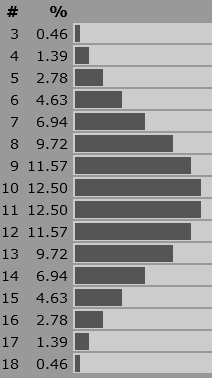
I couldn't think of another image to use. 3d6 outcome spread, from Anydice

Action Resolution

Actions are not abstracted into generic unspecified actions of a broad type. Describe them. Do not have your character "make a light attack", have them swing the sword, or take a defensive stance, or bite their lip until it bleeds so they can call upon the bloodthirsty dark powers they recently communed with. Something actually embedded in the world the game takes place in.

Action resolution is very simple. The core roll is a 3d6 roll on the following table, which represents not the absolute result of the roll, but rather how well the character made use of their capabilities. 

  • 3: Minimal
  • 4-5: Terrible
  • 6-8: Bad
  • 9-12: Average
  • 13-15: Good
  • 16-17: Excellent
  • 18: Optimal

The result is then taken into account along with any number of traits the character has (attributes, skills, powers, tools they're using) that are relevant to the action and being made use of (a tool does not add to it unless it is actively being used). Thus, average does not mean some arbitrary "average for the universe" or "average for humanity" result (unless the PC is themself average in these respects), but rather average for the PC.

This is context sensitive. If the entity is trying to attack something, then it might take into account how strong they are, the weapon they use, how coordinated and swift they are, how dexterous they are, etc. But the weapon may also influence what is given more weight. Strength is a lot less important than leverage when wielding most swords, for example (though it contributes).

Note that this applies even for "contested" rolls, where two entities roll against each other. Rather than comparing the direct numerical result, what each entities respective results mean for that entity are compared. As an example, a "bad" outcome for a wrestling match for someone thrice as heavy than you, and fully able to lift twice their weight, will probably not result in a failure state for them even if you get a "good" result, unless you are significantly strong and skilled enough to close that gap. 

Entities in the game can also either "Boost" an action, or take an "Unrolled" action. Unrolled actions forego rolling, instead landing in the "average" range no matter what. The exact result does not matter, so no roll is necessary.

Entities can always take "Unrolled" actions, unless otherwise stated by an effect of some kind. This is generally the assumed default, though this may vary based on the players and GM. If an action would basically always succeed, this is what happens.

Entities can also almost always "Boost" an action, often more than once! This requires that you make rolls and so cannot be done as an Unrolled actions. When boosting, one or more d6s is added to the pool of dice. Only the highest three dice are read, however. Note that there are diminishing returns the more you put in, as these boosts only serve to push the entity towards the higher end of their own capabilities.

Boosting comes at a cost. The first few are often "free", but it taps in to some form of endurance or stamina, and will exhaust you the more you do it. This may look different for different kinds of actions (physical exhaustion vs mental exhaustion for physical vs mental actions, and weirder things for more esoteric things). More esoteric boosts may be things like blood sacrifices, magic drawing from your life force directly (same result more or less), loss of precise control over the outcome and so on.

Some qualities might actually have the mechanical effect of increasing the number of boosts you can do for "free" (and thus the number needed to actually progress the "exhaustion"). I would also generally limit boosts you can put into a single action to the amount you can do for "free" unless some quality, context, power etc allows for more. This means you cant just dump your entire being into guaranteeing you can make a single roll, unless its justified in universe (or in the narrative, if its that sort of game).

Some contexts may provide genuinely free boosts. If your psychic powers are easier to access in high stress situations, strong emotions may provide boosts. You may have to make an argument for some of these. In some contexts I would also rule that you have to make a rolled action, rather than an unrolled one (because the emotions make you a bit less consistent either way), unless you have some quality letting you deal with it. This choice would forego the free boost, since that requires a roll.

An important underlying note is negotiation. The GM gets the final say, but if you really think you should get a better (or worse?) outcome, then you can make a case for it. The GM has more information than you most of the time (though I would not recommend GMs keep information to their chest for the sake of it) so they can still overwrite your arguments, but negotiation is expected here. It will vary from table to table (even scene to scene) of course.

Other mechanical twists can happen. Some strange things may allow you to flatly increase your capabilities temporarily (or permanently but that's not the topic of this part). This doesn't affect the rolls (boosting is just for accessing your capabilities more reliably, these would be something else), just the interpretation of them. Basically only mess with the actual mechanical core if you want to disrupt how the game "feels" on a fundamental level for some reason.

In other words, the actual game-play happens on the in-universe level, the rolls here are literally just a convenience tool too access some element of randomness. Player characters can choose to either act at their reliable average, or gamble for a better result at the risk of a worse one.


Clock table, This is actually a font iirc. (Source)

General Mechanical Stuff

I tend to track time based on the context. Things which demand immediate attention are in a quick-action moment-to-moment scale ("rounds"). Local exploration/hunting/tracking/other stuff might use 1 or 10 minute "turns" depending on the context. I might track travel and downtime using hours, days, weeks, months, seasons, years etc. Depends on the context.

"Initiative" could be a roll or just comparing traits and only determining if the actions run into each other.

Something I am fond of using no matter the context is "clocks" or "trackers". Set the count (number of segments), and increment (fill the segments) as needed. Great for tracking the worsening of wounds, the progression of curses or diseases, the progression of a complex spell, the amount of a resource left, the awareness of security, exhaustion and so on. Nest them, link them, do whatever you need. Very convenient. If I were to write this as an actual book and needed to pad the page count, I'd include a whole chapter about these (Blades in the Dark popularized them but I don't know if they "invented" them).

For physical and mental endurance/stamina, I generally use a three segment clock. This represents the "free" boosts you get. Each one you use, fill a segment. Once the clock is filled, boosting starts to cause "injuries" (status effects, see the next section). Id rule these as not too serious until you get a couple of them (maybe as much as segments on the now filled clock?), then they start actually becoming really bad, maybe even "permanent" (until such time as you can overcome them).

You could use the opposite of a boost as a mechanical tool, a Suppression. For those you add additional dice but only read the lowest ones. This would represent something that doesn't reduce your maximal output but makes it a lot less likely to happen. Hence the name, "suppression". Just like your lowest outcome is still possible with a boost, so is your highest still technically possible with suppression.

Never roll both at the same time. If you would, they cancel out one to one. A 1 dice boost and a 2 dice suppression would cancel out partially and result in a 1 dice suppression.

However the use case of suppression feels a little limited compared to typical status effects and injuries, since these impact the "in-universe" or "interpretive" layer directly, rather than the mechanical overlay. It would have to represent something rendering access to your average capabilities shaky, but not totally barred. As a "status effect" it would be most impactful to have it also prevent the use of unrolled actions.

For resources you could also use the "usage dice" of the black hack. That introduces more dice than this minimalist system generally supports (d6s can be salvaged from just about any tabletop game which is why so many things use them) so I wouldn't recommend it. Clocks are better for this system in my opinion, though you could do something similar to the magic dice of the GLOG to keep with d6s. I wouldn't bother with that though and I'd either track directly or use clocks. The mechanics are just tools so...

For magic/paranormal stuff its probably optimal to develop a system using the Arcana philosophy I've posted about before. Either in a broad or limited sense. Again, focus on the fiction and the rules of the world, rather than hard "game mechanics."


Depictions of wrestling from Beni Hassan tomb, egypt (source)

Combat and Wounds 

Combat works the same way. Entities act in hostile ways, either make Unrolled actions, normal rolls or "boost", determine what that result means based on the fiction and then compare actions.

Damage is not a loss of some abstracted "pool", but rather a series of in-fiction descriptive outcomes.

The severity and effect of damage is based on the type of damage, location and various qualities, all of which are based on the fiction and the combat results.

Weapons improve the lethality of damage and have specific damage types (reflecting the nature of the damage they deal). Armor reduces it. For example, plate armor in a medieval setting will render you impervious to most damage, rendering it trivial or even totally ineffective. Arrows will smack into the breastplate with little effect, and so on. Even low caliber ballistics will "ping" off the breastplate.

High rolls with high enough dexterity/skill may find gaps in armor. Depends on the described actions. If its just "I hit it" it may not. Aim for the weak spots. Describe actions. Get fun and strategic with it. Fight dirty if you have to.

Damage is essentially "debuffs" and "status effects". It is descriptive, and contributes (negatively) to the action resolution the same way qualities and skills do (but in reverse). Additionally, they may have worsening effects (cuts bleed, fractures worsen, organs fail). Damage will look different to different things.

In my first draft of this, I was compiling a list of tags for wounds. However I realized that a set list of tags clarifying severity and type/effect wont be the most useful for this "fiction first" philosophy, as wound severity starts to get a bit arbitrary/multidimensional at a point. A major gash or disrupted organ is more immediately dangerous than losing a bit of your outer ear, though the gash/organ may heal more totally than the ear, and something made of stone will have a completely different way of "taking damage" than a biological organism. It all depends.

I am however fond of distinguishing between totally ineffective damage, and "trivial" damage. Totally ineffective doesn't really do anything, while trivial damage can have secondary effects tied to it, or eventually exhaust your character or exacerbate into something worse. Again this can be done through description, and the two aren't even really totally separate anyways (since a bug sting is "trivial" and can inject non-trivial venom, but a bug that can damage the skin but not reach far enough still did something even if it wasn't enough to do that so...)

So as usual, the system is descriptive rather than prescriptive, and the fiction comes first. Much of this section is mostly to help me get into the proper mindset of this system and others may have less issues than me with getting over that "bump".


I just kinda wanted some cool looking art/diagrams for this section. (Source)

Characters

I'm fond of a "five question" or even "life-path" approach to character creation. The five questions may have multiple answers ("what people were you born to" may just be the culture you live in, but it might also account for fantastical peoples and social strata/class as well, as separate but interrelated answers) or not.

Life-path is a bit harder since it requires a bit more of a session 0 for each player, but is potentially more rewarding. It may cause some friction/be non-viable if its a high-lethality game however.

Character traits/aspects are less "a list of skills" and more "a description of the answer to a question/the characters capabilities". Think less "archery +2" and more "A skilled bowman". Or perhaps, "A skilled huntress", with more of a description of what that means in context. These will of course, imply different things, and each will offer multiple skills.

Even in that case, I prefer something more descriptive than "A skilled huntress". Give some context. Who trained you? What was the training like? How did it impact the physical appearance and psychology of the character? 

I usually also say that a PC gets at least one "Item" per "Answer" based on what it is. With life-path that's a bit different, of course, but this keeps things easy. As with anything else here, you can do it a different way.

Remember the actual traits are what contributes to the interpretation of your rolls. Negatives can still get you things though, and not everything will be linearly "good" or "bad". Some might be a re-assessment of capabilities. 

Character Improvement is multidimensional and nonlinear, based more on in-universe events than anything. You may get scars, diseases, curses, lose limbs etc, but you also may improve your skills and your qualities, develop otherworldly or inhuman abilities, collect treasure and agreements and so on. A lot of horizontal changes. You may, of course, just improve linearly in some way, but that will also be justified (far more practice with a bow, if using the archery example, or maybe being blessed by a spirit or goddess or something. Depends on the game).

The only real limit to improvement is the limit in-universe, which might be more a "Plateau" or "Bottleneck" depending on the context. In a sci fi game maybe your natural skill and attributes can only get so effective, but maybe you can break these limitations with cybernetics, biological enhancements and psionic powers.

Maybe a more fantastical game could have a more abstracted form of power you can "harvest" from enemies (or even victims?) like the various forms of "experience" spread through the soulslike games.

You don't have to be vague and wishy-washy on the details of the character, just use more real descriptions than "strength 40". "200 kilos and can lift 3 times his body weight overhead with little effort" is far more descriptive. The way you describe this will likely also be impacted by the exact game and setting too, as it should. The above example may become "heavy as a gorilla, and strong as a bear" in a stone age game, for example. 


Notes 

I mostly wanted to get this out so I could reference back to it for any other game that uses it. The first version of this was specific to Kith and Kin but I realized I wanted to use it more broadly, and didn't want to necessarily have people look through a larger game/setting article every time I wanted to link them to this framework.


Saturday, February 8, 2025

Tools of Kith and Kin

 I realized theres a major possibility that players of Kith and Kin wont know exactly whats available to them, tool and technology wise.

Now I could go over every lithic industry that would be available to them, with a note on who would use it. That was my original idea for this post! But there's a lot of those (which I knew, but it took me reviewing them again to realize just how many there are).

I could do it anyways, people sort of know what they're getting into when they agree to have me run a game, but even my energy runs thin going through all the various ways people made use of the world.

So instead im going to go over a handful of very very generalized categories of tools, and who would make use of them, organized by rough level of complexity.

Note that there is actually an inverse of expectations in some cases here. Someone from a settled agrarian society who is not a "toolmaker" will likely start out only understanding the basics of some lower-paleolithic tools. The tools one understands do not strictly correlate to the intellect one is capable of, but more reflect how specifically one understands they can alter their environment.

Rough time frame with regards to the real world is also given in parenthesis.

Images are all pulled from Wikipedia. Note that pretty much all the information here can also be found (in greater detail) on Wikipedia, but not everyone wants to scroll through three dozen pages of scientific jargon to figure out what sorts of tools they can make. To be quite honest, I'll mostly just let Player Characters make whatever tools they have the time and resources to make, but I might use this as a rough guide to determine what their fellows use/what techniques they might use for descriptive purposes.


The stick is probably being used to gauge the depth of the water.


Pre-Lithic (>3.3 MYA)

Natural objects, with minimal to no alteration. Sticks broken at an angle, splintered bone, or very basically fragmented rock (or simply rock that remains unaltered). The logic here is around immediate convenience, and the basic understanding that objects have properties that can be useful. Sharp things stab or cut. Rough things scrape. Heavy things break other things, and so on. 

These tools are some of the most basic tools available to anyone, and are only depended on by the painfully archaic and isolated, extremely sheltered, impatient or rushed, those animals that are intelligent enough to make use of altered objects, but lack the physical or cognitive capacity to alter these further and children.


Top Left: Oldowan chopper. Top Right: Acheulean Hand-Axe. The hut has been proposed to be middle paleolithic, but thats the latest possible time, and not everyone agrees with it.


Lower-Paleolithic (3.3 MYA-300k YBP)

The introduction of "flakes" and "cores", the former being the pieces chipped away from the later, which is the central mass of a stone. Time is taken to chip away from a rock to create a shape, and care is taken to make use of the shape. Additionally, flakes and cores are made use of when possible, though most seem to derive from convenience. Basic hammers, choppers, chisels, scrapers and awls appear here. Purely wooden spears would be utilized at this time, sharpened with scrapers or chisels.

Later tools include the handaxes, which lacked handles at this stage and would be held on the opposite side of the chopping edge. The construction of tools would include the use of bone, wood and other objects to alter in ways more specific to the purpose.

The lack of adhesive in this era would preclude the use of handled-tools. The hammers were essentially stones altered to make the striking end more useful to a specific purpose, the axes were sharp stones and so on. Wood was still used, due to its ease of alteration, but was not used in the same tool as stone, unless one contributed to the manufacture of the other.

The very basic control of fire is an element of this category of technologies. Basic hidework and tanning arises near the very end of this, and more advanced leatherworking arises in the next category.

These tools are largely used by isolated and archaic wildfolk, settled people who are unfamiliar with the construction of tools beyond the basics and others with an understanding that tools can be made over time.


Speculative reconstruction of Neanderthal Jewelry.


Middle-Paleolithic (300k-50k YBP)

More advanced still, preparation methods are developed. In the real world, this is when "behavioral modernity" starts to arise, art and spirituality, concerns beyond mere survival. In Kith and Kin, however, such things precede these industries.

The prepared core technique is a defining technology of the flake-built tools of this class. The stone is shaped into a form that serves to facilitate an easier extraction of a shaped flake, that then only requires minor touch-ups to render extremely effective. This technique is the bread and butter of this time. There are numerous techniques, but I have included a GIF of one technique to illustrate a somewhat hard to describe method.

Levallois Core Preparation, demonstrated. Thanks Wikipedia.

 Cores are still utilized in the expected way, generally for heavier duty tools, though the more advanced methods of flake production mean that more effective core-tools can likely be used.

Adhesives are discovered here. Such flakes and cores could then be affixed to a shaped shaft of wood, producing the most dangerous wildly used weapon of the entire world of Kith and Kin, the Spear. Handled axes and hammers are possible.

Fishing becomes a thing, thanks to spears and some nets. Long distance trade happens. The earliest seafaring also happens, likely hollowed logs carved into very basic boats, though later refinements are certain to happen.

Extensive use of clothing, likely by the Neanderthals/Broadfolk due to the colder climates they dwelled in, arises around this time.

[Sidebar] Researchers actually determined this by tracing the mutation rate of the human louse and comparing it to related organisms to determine when it would have speciated. Since it requires clothing to transfer between people, its rough range of speciation can give a rough area for when clothing was starting to become a Major Thing. This ends up around 170,000 years ago being when humans were definitively wearing clothes by, though earlier dates are almost certainly when it was first introduced. Given the climates and habitats then, the theory is that neanderthals actually invented clothing, and we merely adopted this technology once it became necessary. [End sidebar]

Control of fire becomes a widespread element of technology at this time, though very basic use of fire precedes this. This is likely to be the technology that grants anyone who vaguely understands it an advantage.

Every forager society in Kith and Kin uses this, except for the settled folk. In kith and kin it is largely mixed with upper-paleolithic technologies in a rather even way. The use of either depends on convenience, knowledge and what would work best at the time.


Top Left: "Lion Man" figure. Top Right: Flint knives. Bottom Middle: A flint core used to extract multiple knife blades.


Upper-Paleolithic (50k-12k YBP)

A greater understanding of the properties of natural materials allows for the use of flint and similar stones to produce fine blades, rather than the typical flakes. Previous advances are made use of liberally. Sharp points lead to the use of darts, harpoons, fishooks, eyed needles and indirectly to the existence of rope, rather than simple fiber cords.

Multiple fine blades might be extracted from a core. Adhesives improve in quality.

Even stone-carved oil lamps appear, the oil drawn from the flesh of hunted animals.

The first evidence of earthen ovens arises here, really just fire pits, but realistically cooking has been a thing for a long long time at this point.

The very oldest permanent settlements arise. Not farming communities, still foragers, just living in a single location for much longer.

Additionally this time carries the earliest signs of Australian Aboriginal culture in the real world. However the earliest theoretical evidence dips back into the middle paleolithic.

The dogpact is honored. This applies to the previous too, but here is when it was first enforced. Domestication is thus "A thing" for at least a single species.

Effectively any stone technology is theoretically available at this point, limited only by contextual need and available time and resources.

Figurative and symbolic art begins to arise in earnest in the real world, though these things have been around for quite some time in Kith and Kin.

Gold dust and fragments have been found in some sites, but this is difficult to assign any actual context to. It is possible it was utilized in some decorative capacity. As a softer metal, it would be less likely to survive weathering.

Once again, just about every forager culture knows this in kith and kin.


Mesolithic temporary settlement.
The Shigir Idol


Mesolithic (20k/15k-10k/5k YBP*)

Smaller fine tools begin to appear more than heavier flake tools of the prior eras. Large settlements begin to appear and more advanced weaving leads to the use of baskets and tighter-threaded clothing. The use of ceramics also appear at this time.


This is an interstitial period, and as such describes less overall change, and more lifestyle differences. Settled forager cultures, the earliest proto-pastoralists.

This is rare but present in some cultures. Weaving has spread far, but ceramics are more difficult to spread due to resources available. This is partially responsible for, and partially because of, the staggered timeline of Kith and Kin.

*Depending on the area irl.


Reconstructed Neolithic farmstead: Ireland
'Ain-Ghazal statues, oldest statues of this level of detail.
Reconstructed neolithic housing, Aşıklı Höyük


Neolithic (12k-4k YBP)

Large settlements thousands or even tens of thousands strong, many of which with social organizations that may or may not be hierarchical. Agricultural emergence leads to the necessity of tools to aid it. Wool and Linen may be available at this time, and definitely are in Kith and Kin, implied by some remnants that may be early spindle whorls and loom weights

Stone tools are mostly polished or ground down, rather than flaked.

Mud brick homes are constructed. Architecture was already a thing in mild amounts, but it becomes more important here.

Finer points and blades are possible with these methods, though in some cases the used material may still render it inferior to some paleolithic tools.

Food storage is a thing, but is imperfect. Sanitation differs. Social roles differ. Specialization becomes more viable. Everything changes for these people. Pottery arises. Proto-writing begins to emerge.

Bellows of some kind may develop and make the creation of copper tools possible. Mostly worked raw copper, hammered into the needed shape. Cast copper is the domain of an extremely small number of very small cultures at the moment.

The neolithic of kith and kin has begun and shattered in earnest several times. New settlements are often built on the foundations of old, or in some cases have some persistent cultural context that remains relevant.

These are available to the settled folk, and those in their immediate proximity, who have need to emulate some of the technologies with regards to clothing and lithic production. Though it is possible some other forager cultures could independantly arrive at some of the finer sewing methods, lithic production methods and so on. The staggered timeline makes all of this possible.


Weirdness

Of course, the timeline of Kith and Kin is far more "staggered". Technologies have been discovered, lost and rediscovered a few times over, and other species have had some cognitive capacities possibly exaggerated, though I would argue that in the real world other human species may have been more intelligent than we give them credit for generally speaking.

Magic means some things are possible that aren't irl (unless I have been hilariously misled about the nature of irl magical practices). Despite this magic is not going to be "industrialized" or a "technology" the way most other tools are in Kith and Kin. Magic in kith and kin isn't a science. Its this weird shit. A toolbox of rules and associations that can be exploited. Sure thats arguably the definition of a technology, but it requires a different mode of thought to properly understand.

And spirits of course. Spirits. The world is lousy with spirits. Its quite literally made of the damn things.

So whats available will be a little strange and not quite match up with the above. Thats fine. These already serve as extremely rough categories irl and dont reflect the more detailed understanding of material culture differences across space and time. This is just a rough guide.

Friday, December 27, 2024

Beyond Vancian Magic: Applied Arcana

 I was already planning to make a post about the "Arcana" of Kith and Kin, as a demonstration of how Arcana can be used to color the magic of a world and shape its structure. Then the blog carnival started and what do you know, its about non-vancian magic! Neat!

If you're unfamiliar with my "Arcana" design philosophy of magic, here's a whole post explaining it. In short, "Diegetic Magic" is a good enough summary.

Idk what I'm supposed to do to get this to count for the carnival. Guess I'll just post it where most of those are.

General warning for some stuff that is typical to magic. Animal (and human) sacrifice, mental effects (mostly under the "possession" section) and discussions of sympathetic and similar magical connections that can agitate some elements of psychosis and OCD. Take care of yourself.


Kinds of Arcana

For the purposes of Kith and Kin I am going to split Arcana into three major classifications. This is not how arcana in general, that is "across games", work. This also isn't strictly a recognized in-universe split.

Also in-universe these will probably be called something along the lines of "Wisdoms" or "Magical Secrets". "Arcana" feels too "modern" a term.

Regardless, its a useful way to approach them from a design standpoint.

Root Arcana are some basic facts about the world. Core assumptions that build the rest of the magic system in this case. They are like the "laws of physics" or the "fundamental forces" of magic, or possibly more like "Themes."

Branch Arcana are any arcana that result from the former. They are learned or developed individually, and suggest at at least one Root Arcanum. These are examples of actual magical activity.

Leaf Arcana are specific, distinct magical things, rather than broader skills or consequences like Branch Arcana. Listed examples are more akin to game spells, though some powers are listed in the examples.


A Note on Consistency and Fairness, I generally will require 3d6 rolls for magical actions, with the ranges of 3, 4-5, 6-8, 9-12, 13-15, 16-17 and 18 corresponding to different levels of success. Context and skill with increase and decrease the number of d6s added, though only the top or bottom 3 will be counted. What is possible is thus a bit context-sensitive. Its more important that this system feels consistent and fair than it actually being those.


Root Arcana

There are five, listed and described in no particular order. Magical workings can be subtle or flashy. Subtler magic is easier and more common (and is more "real" in that it feels possibly coincidental or circumstantial) but flashier magic does exist.


Altered States: The cosmology of Kith and Kin is psycho-spiritual, and in order to tap into the intrinsic power held in the cosmos it is sometimes necessary to uproot oneself (even if temporarily) from some basic perceptions and assumptions. Thus, altered states of mind are (generally) necessary. These can naturally peel back the perceptions of the world to reveal the spiritual realms entwined with it, and that is one of the core benefits of these, but it is often necessary to dip into them in order to access truly flashy magic.

There are five rough levels of these for game purposes. Minimal (Minor, Tone-altering), Weak (Minor, Minuscule game effects, slight hallucinations), Powerful (moderate bonuses/maluses, flashes of other realms, can see spirits), Heroic (Entering other realms entirely) and Extreme (cutting straight to the heart of another realm).

The levels are a combination of Pariahs measurements, with the first two instead becoming three akin to this Altered States system.

Importantly, this means there is a certain level of subjectivity in the cosmology and metaphysics of Kith and Kin. Its not entirely "post-modern", but individual experiential phenomena are Important in a cosmological and metaphysical sense.


Spirits: Kith and Kin is animistic, but its also weird. Spirits have no true universals, other than that everything is technically a spirit (or multiple spirits) and that they are more beings of their own nature than anything else, obeying their own structure over any "physics." A spirit of the land can do "spirit of this land" things quite easily, especially within the space it occupies, but beyond that it might struggle. A free spirit on the other hand, may be capable of acting just about anywhere, but might be limited to some phenomena. Spirits (much like spiritual realms) are not limited in what they can be. They can be ghosts, elementals, animal souls, your own souls, dream characters, shadows, people from other realities, alien consciousnesses, animate concepts, stories that have taken on a life of their own, elements of personal subjective experiences and many more things.

Spirits can be called upon for magic (invoking them in a ritual), or targeted by it (as with summoning and binding). Generally they are limited by their nature and whatever cycles (if any) they follow. They are not omnipotent but they are potent. Magic users who mostly rely on spirits are something like paleolithic diplomat-priests, negotiating with spirits on behalf of their community (or just themself, as the case may be).

A detail that also applies to the next arcana, is spirits explain a sort of "inertia" the world(s) have. Subtler magic is easier because spirits (including ones own souls) resist changes from outside.

What they do can be subtle, flashy or anything in between. Depends on the character of the spirit really.


Souls: Your own spirits. At least five are widely recognized, those being the physical shell (body), the vital breath/blood/movement (life force), Free-Spirit (subtle body) and Waking-Spirit (the mind). These might have further subdivisions, or be classifiable, but as with other realms and spirits there is a certain subjectivity to this.

Your souls are part of you, so you have a certain level of assumed power over them. Your souls also generally explain any magical talents you might have. Prophetic visions, Ghost-Walking, natural tendency to slip into altered states/other realms... These can also often be described by naturally existing in a semi-altered-state at all times (or falling into them easily).

These can be a path to power. There might be a part of your soul that relates to simply "Magical power". It would be extremely weak at first if you have no talent for it (i.e. no Trait relating to it), and even then it wont be anywhere near extremely impressive. Twists to ones soul can also encode mystical powers, "spells" of a kind. These are less like "wizard spells" and more like "Things you can now do and train up in power."

These can also be affected by magic, of course. Most "curses" or "talents" are some twist or distortion to ones soul(s).


Esoteric And Exoteric Connections: Binding everything together are connections both obvious (Exoteric) and subtle (Esoteric). An Exoteric connection is simple. If A causes B then A and B are connected, much the same if B causes C. An obvious causal connection.

Similarly, physical contact is about the most obvious physical connection possible.

Esoteric connections consist of those less obvious connections via some subtle aspect of reality. Some basic examples are sympathetic (like affects like), correspondent (things look like what they are), contagious (once together always together), symbolic (the image is the thing, representation grants power), composition (the part can affect the whole) and so on.

These connections exist by default but can be protected against (often by using other connections). They weave into spirits and souls, thus summoning spirits requires objects, times, activities, locations and so on that are "linked" to them in some abstract way.

This is the principle that also allows you to call upon spirits to help with magic, and is why you cant just use any damn thing to do anything.


Sacrifice: The balancing principle. Put simply, "You get what you put in." This is the element that suggests the more time, blood, sweat, tears, lives and so on put into a work the stronger, broader, deeper and so on it will be. This doesn't mean you need sacrifice to do magic. A circle scratched in the earth with a prayer of protection (or a promise of protection) will hold some power, albeit only enough to protect against the most impotent spirits and/or animals. This is similar to altered states not strictly being "required", but helping a lot.

Some costs can be easier. Some souls beings have might have natural power or energy to expend, but this is not strictly default (except for some spirits perhaps).

This is less conservation of mass/energy and more conservation of "fairness". A "curse" or pain or a "trial" can be a cost. Sometimes the "Cost" is paid to some specific thing directly, such as a spirit, and sometimes it is simply fuel for the magic itself. This isn't thermodynamics we're talking about. Its magic.


Branch Arcana

Branch Arcana are constructed from the assumptions of the Root Arcana. There are infinitely many, but some examples in no particular order might be...

  • Spiritual Sensitivity: Some individuals have a natural tendency to slip into altered states of mind, as a consequence of some spiritual sensitivity in their souls. This allows for ease of entering magical mindsets and seeing spirits. This will combine with other "talents".
    • Soul Flight: Often when the natural altered state enters a "heroic" dose, it often allows for soul-flight rather than simply entering another realm, though that can still be a consequence.
  • Divination: A skill. Using some mild spiritual sensitivity and possibly lower altered states to read subtle connections across space and time.
    • Prophetic Visions: Altered states up to Heroic, with Heroic slipping fully into the vision. Can be drug-induced, or a consequence of spiritual sensitivity. Rely on subtle connections and altered states more severely.
  • Bestial Communion: Subsisting off the entire body of an animal of moderate size (or a sufficient number of smaller, or portions of a larger that have the preserved ratios of tissue varieties) ritually, often in an altered state, one can take on the aspects of various beasts, birds and even crawling things like insects and worms.
    • Therianthropy: Physical transformation into a beast or beast-hybrid. A curse, so "sticky" magic tied to the self and thus soul. Often done as punishment, but due to the dynamic nature of the soul it can twist and warp from a curse to simply a thing you can do. May be possession by an external spirit instead. 
  • Summoning Spirits: Conjuring spirits requires reagents and actions, contexts really, related to the spirit. A bloody spirit of the moon for example might require the reflection of the moon and blood dissipating in water. Often an altered state of mind is required, to more properly tune oneself to alternate realms, and sacrifices to lure or draw their attention. Rarely, simply calling their name can be enough, if the relationship is deep enough.
    • Realmwalking: The ability to bring ones physical body into spiritual realms is a rare capability indeed. One possibility is allowing some spirit to summon you, as you might summon them. This is rare, as few spirits want to summon something that combines impotence and capaciousness as well as a mortal does, and most mortals loathe to grant that kind of power over oneself, but it is done sometimes. Other methods involve altered states and similar kinds of magic to summoning. Im sure you can develop your own ideas at this point.
  • Binding Spirits: Bindings require using some sorcerous method to restrict the available actions of a spirit. A basic example is a circle scratched in the dirt charged with some sacrifice, which restricts the movement of a spirit. The circle demarcates an interior and exterior and the sacrifice charges it with some power beyond simply time, effort and hope. Other forms of binding are possible.
    • Living-Dead: Binding spirits to a corpse-vessel, granting the spirit control over the dead body. If bound properly, a loyal and possibly powerful servant can be gained. Weaker ones are easier to bind, obviously. Sometimes spirits will let themselves be bound to vessels to gain bodies.
  • Possession: Often times spirits (and magic in general) cannot simply overwhelm the will and mind of a host, due to the spiritual inertia of ones own souls. The exceptions are particularly powerful spirits and magic, and contexts in which the will of the host is compromised, such as sleep or some altered states. Instead, warping emotions, sensations and memories are often required to shape the behavior of the host, but the host still has inertia and can often resist these.
    • Hauntings: Possession often requires either extreme power or extreme subtlety, which most spirits cannot provide in the required amounts to actively impose themselves. Even the subtler manipulations require one to possess enough power to redirect the inertia of the hosts soul in some way. Thus, hauntings are often the preferred dominion of spirits and most will want to simply possess a dead or "vacant" body if possession is required. These cause effects to the host, but are more akin to things happening around them, such as poltergeist activity. Still, small changes to the host (such as bouts of pain, twitching or brief hallucinations) often occur.
  • Curse-Dolls: A representation of someone, built from cloth and stick and charged with locks of hair, blood or even small bones taken from the target. If the link is extreme enough, it can act as a stand-in for the person themself. Subtle connections such as these are incredibly useful, and despite the name curse-dolls can be used in a way beneficial to the target.
  • Magical Languages: Languages spoken not with the physical tongue, but with the subtle elements of ones soul. Often allow for communication with inhuman spirits (or folk who do not share a language) without an altered state. This consequentially allows one to communicate, and thus attempt to change their behavior. This is done very similarly to how one does with other people. Threats, bribes, offers and so on. Some examples are:
    • Fur-Tongue: Mystic language of beasts with fur and fang.
    • Scale-Tongue: Mystic language of the scaled creatures of the land. Includes landbound feathery things.
    • Wing-Tongue: Mystic language of the things that fly and the winds they ride.
    • Shell-Tongue: Mystic Language of things with hard exoskeletons.
    • Water-Tongues: Mystic languages of the aquatic spirits and beasts that occupy them. Split into Rivertongue, Laketongue (Includes ponds), Seatongue (Includes near the surface of the oceans) and Oceantongue (primarily the vast lightless depths).
    • Root-Whispers: The whispering language of the forests and all that compose them, including the fungal threads. If understood can be "heard" (smelled?) as a faint murmur if one head is close to the ground.
    • Celestial-Thundering: Thundering language of celestial spirits, quite literally thunder. Dangerous to speak. Storms may provide some information, but are often just involving warcries.


Leaf Arcana

The provided examples are more akin to "spells" from other games. Think of them like dnd "cantrips" that can be trained to be stronger, more complex, and so on. They can also be enhanced by increasing whatever cost is built in to them. Other "Leaf Arcana" exist, but most of the ideas I had are more akin to these. Summoning and binding rituals for specific spirits would also be examples. The names are just for flavor. Most of these involve twists to ones souls allowing one to cast them naturally, but leaf arcana are not restricted to just "spells". Its just a name for any very specific magical thing one does.

  • Fires of the Heavens: A gift given by (or stolen from) celestial spirits of the upper air. Heavenly fire is infused into the flesh. When called upon, one may unleash the pure power of lightning, and the thunderous after effects. The sorcerer is only mostly protected from the effects. The cost is that calling upon it may cause seizing, electrifying pain and burns, depending on the power.
  • Dead Flesh Obeys Me: Casting off small parts of ones own souls to animate dead flesh with the mere motes of spiritual power one has birthed. Painful and exhausting, often involving sweating blood or layers of skin stripping away to fuel it. Crudely animates dead flesh for as long as one can withstand the pain and remain focused. More like disparate body parts clawing and flinging themselves around than anything sapient.
  • My Own Breath, Commanded: Using ones own spirit to sieze control over ones breath, something which is already "under your power" and thus easier to control. Allows very mild control over the winds to begin with, honestly like a large number of people blowing fairly hard, but greater exhaustion and training can improve this. Requires one breath out if it blows away from you, and breathing in if it blows towards.
  • My Pain Wounds You: Forcing a causal sympathetic connection to a target, and magically altering what actually carries between the two. Pain transformed into actual wounds. Can be made easier by suffering actual wounds in the casting.
  • The Cold Touch of Death: Ritually allowing ones hand to become frostbitten, and binding deathly power to the dead flesh of the hand, magically preventing it from causing horrible infections and necrosis. The hands still functions as a hand, but is crude, numb and slow, unable to precisely move. Its touch carries the horrible chill of death and frost with it, to any who touch it, regardless of intent.
  • My Dreams Laid Bare: Using ones power over their own dreams to project glamours of sensation, emotion and memory into the world. Flimsy and easy to "wake up from" at first. Effectively no cost, except for the focus required, but very very weak at first, requiring training to bring forth greater effects than prickles of sensation, bursts of intrusive emotion and subtle deja-vu.
  • The Glory of Daylight: Minor celestial spirits of the daylight sky are bound to ones own souls, carrying a mere fragment of the suns brilliance. A bright aura of light springs forth from the sorcerer, carrying the mystical effects of daylight for a small area. Unfortunately, the temperature of the sorcerer will increase with each moment, faster the brighter the light. This will only stop and begin to reduce when it ends.


 Questions?

I welcome questions about this since they'll help me define this better and better, while keeping the magic system abstract enough to still "work" as magic rather than science.

Saturday, November 11, 2023

Kith and Kin: Character Creation (And Basic Mechanics)

 Hard, unbending mechanics are not the system I feel Kith and Kin should be represented in. Fully freeform isn't my favorite way to run a game, but FKR fits a certain level of comfortable flexibility for me.


Cueva De Las Manos, "Cave of the Hands" in Argentina.


Core Mechanic

If a player character or other acting thing within the world attempts something, consider whether it will automatically succeed or fail. I default to these to keep the game going. Sometimes I'll instead have the referee (so, me) roll for certain results, if they rely on things outside the players control.

In cases of ambiguity, such as combat or other contests where participants and circumstances lead to difficult to predict outcomes, I prefer a 3d6 roll. It has almost the range of a d20 roll, with a rather nice bell curve that makes even small bonuses useful.

Thank you Anydice.

This roll is either attempting to meet or exceed a target number, or is against an opposed roll. I prefer the later, personally, it makes things more difficult to predict in these circumstances.

Modifications to this core mechanic are easy and possible. Tiny bonuses are okay, but I prefer biasing the rolls in other ways.

Specifically, advantageous traits and circumstances can allow you to roll additional dice in the pool, and drop the lowest number of dice equal to the additional ones. You can do the other way too, with disadvantages, just dropping the higher dice instead. This is described as giving one or more "dice" of advantage or disadvantage.

Advantages and disadvantages cancel each other out, to an extent, unless there's a reason for one of them to simply not apply. Then its not really an advantage or disadvantage.

This is used in character creation in other games sometimes. It pushes up the probability spread a bit. I like it, its rather basic and still leaves room for error (though unlikely the more dice you add).

For combat, I just take how much the attacker succeeded by, and whatever weapon they're using, and sort of eyeball how badly they hurt their target. Wounds are narrative, but can work as disadvantages too.

I also use "clocks" with "ticks" for things like bleeding out, disease, certain curses, etc. Smarter folks than I have explained those before. Again these aren't hard mechanics, more shorthands for my convenience than anything else.

This core mechanic is my default system for FKR games. Of course, if it gets to the point where you think someone would just succeed, or just fail, then just go with that and don't even roll.


By Ettore Mazza

Character Creation

First, select a people. This will provide some one dice advantages and disadvantages based on the group you select.

Some possibilities are

  • Youngfolk: Can use projectile weapons without a spear-thrower or sling thanks to having a waist. Higher self-control. Can switch rolls or skills faster than others. Look young. Tallest. Frail for their size.
  • Broadfolk: Tough and strong. Resist cold easier, more neutral on heat. Better visual perception. Require more food.
  • Smallfolk: Smaller. Require less food and drink. Can work together and get along with others easier. Weaker and more fragile.
  • Treefolk: Smaller, but less so than smallfolk. Can climb much easier. Using tools is a bit more difficult unless built by them (hands work a bit differently).
  • Elderfolk: Hodge-podge of benefits from other "Kin" groups depending on the Elderfolk. Either less specialized or hyper-specialized.
  • Wildfolk: Hard time speaking, but have fur. This makes you tougher, able to survive cold easier, but less endurance in heat. Easier time climbing. The more wild, the more primate-like, the harder it is for you to relate to the tools and behaviors of the Kin, the better "natural" traits you have.
  • Underkin: (Not done yet. I swear I'll make a post on them eventually. They deserve their own.)


Neanderthals with Modern Humans (By the Kennis Brothers)

Next, select what role your character played in their former society. This will provide some skills and potentially even some other advantages. Skills usually allow you to simply do things that others might have to roll for, and lets you roll in circumstances others might just fail. Other times they might provide a dice of advantage. Some possibilities are...

  • Craftsperson (provides skills in a handful of crafting disciplines. Can include cooking.)
  • Forager (everyone can forage, you're just really good at it. Includes fishing if bodies of water were in the area. Probably line or net fishing.)
  • Hunter (combat and tracking. Also includes fishing, though probably more spear-fishing.)
  • Wise-one (herbalism and spiritualism. An initiatory secret...)
  • Entertainer (song and dance, storytelling, Performance)
  • Leader (Keeping people calm and/or effective, Being heard, Making sense)
  • Farmer (Farmwork. Ideal conditions for plants and animals. Selective breeding. Less useful as a nomad.)

Others are possible. The bits in the parenthesis are meant to be skills you can have, and are more of a rough guide than anything concrete. Bit of a theme this post, it seems.

Some can be from more settled cultures, but will provide less useful advantages to surviving in the wild.


Looks-wise, these are somewhat-kin-adjacent Wildfolk. Behavior-wise,
it varies. Some are nice, some are not. Just like people. (From Primal, the show)


Next, select one (or more, depending on the ref. I'd require more disadvantages to take more than one) secondary quality to add some depth. This is like the role you had, but is less categorical. Some possibilities include...

  • Physically fit (Overall more athletic than your fellows.)
  • Iron Guts (Hard to poison or get drunk/inebriated. Resist venom.)
  • Ascetic (Need half as much food, drink and comfort. Just not as affected by their absence.)
  • Spiritual Affinity (Can more easily slip into altered states of consciousness. Useful for sorcery, spiritualism and mysticism. Might accidentally slip into them sometimes, especially if something is trying to catch your attention.)
  • Learned (More likely to just know things. Biased towards the culture you are from.)

Again, others can be possible. Work with your ref.


"Gabillou Sorcerer", I'm unsure how accurate
this interpretation is. Its cool regardless.


Finally, determine why you were exiled from your former culture. These are mixed advantages and disadvantages. Some possibilities include (but are not limited to)...

  • You made trouble. For whatever reason you simply were not compatible with the culture or authority of your former tribe. Sadly, you're prone to making trouble in other large groups too, but you're definitely good at stirring up peoples animosity towards leadership...
  • Sacrificial treatment. You were either selected for a sacrifice, or your banishment was the sacrifice. Either way, this weighs on you in some way. It might lead to preferential treatment by some unusual things though.
  • You were taken, not banished. In a raid or war, you were taken as a prisoner. You escaped. Fortunately, your old tribe would welcome you if you found them again. Unfortunately your former captors would also welcome you back if they found you again.
  • Endling. Your tribe was obliterated, somehow. This is unlikely to be your fault, but that might not be entirely the case, depending on the situation.
  • Forbidden Sorcery. Gain an initiatory Secret. If you were a Wise one, you may choose to gain another or deepen your understanding of your selected initiatory secret, or gain the favor of a forbidden spirit. The more powerful, the less attention and differential treatment you'd get. You might owe something.
  • Mutant. Some physical difference sets you apart from others. Real-world disability and disorders probably don't fit here, since there are entire tribes in which these differences are just a natural facet of that culture. Its probably something clearly unnatural. How did you get it? What is it?
  • Cursed. Highly variable. Perhaps you are a therianthrope, haunted by a spirit, or worse. Work with your Ref to determine how this works out.

Lastly, select one or two items/objects for each section up above. Food and drink for a few days as well as some tools are recommended. The groups should have at least a few weapons as well.

Your goals are survival... And whatever goals you make for yourselves, or develop naturally from your interactions with the environment and peoples.


Wednesday, August 23, 2023

A Magic System: Arcana (Secrets With Power)

I don't even know how you'd define this magic system. Its not quite freeform but its not quite limited either. Maybe "Diegetic Magic"? It definitely is a magic system that works with FKR games thats for sure.

The origins of this magic system lie in my enjoyment of the game "Noita" and its magic system. Its spells have properties that you can learn and exploit to ridiculous effect. The game is kinda about that.

However, while generic spells and modifiers work for Noita, Tabletop games require a bit more work. And so, after some time, this "Arcana" system was born.

The idea is to incentivize exploration and experimentation, and to make magic feel like something truly embedded in how the world works, rather than a game abstraction.

Making a potion can be easy, but it can also be like if chemistry really wanted to eat your soul. (Source)


Arcana

Arcana is anything that knowing about can grant some form of supernatural advantage. That isn't to say that knowledge of it is inherently powerful (conversely, thats not to say that knowledge of it isn't inherently powerful either), rather knowing about it opens up the capacity to interact with it or make use of it in some way.

Arcana can be anything, but as a list of examples they can be supernatural skills, languages, esoteric energies, otherworldly forces, groups of entities, anomalous mathematical principles, systems of logic, beliefs, states of consciousness, other realities, subtle aspects of this reality, gods, concepts, substances, processes, properties of otherwise natural things, psychological complexes, a series of specific actions, anomalies in how the world works, natural laws taken in bizarre directions and basically anything else you can imagine.

Arcana aren't spells. They're not rituals. They're not magic items. They're not (strictly) powers and they're definitely not a "class feature." They're meant to be the building blocks of these things, however (except for class features, maybe). Think about how during a ritual the magician calls upon various entities, draws magical circles, and more. Arcana are like these things rather than the ritual itself.

Whats important is that Arcana have properties and that these properties can potentially interact under the right circumstances. This doesn't mean you need to have a huge list of how different arcana interact, just that there needs to be at least consistency. If one arcana is an altered state that involves extreme self-awareness, and another is a psychic parasite, these can probably be used together in some fashion (perhaps as a way to control the parasite? It depends on how the two work exactly).

There's no hard categories of Arcana. Some are more broadly applicable, some are more useful in specific contexts, some are quite dangerous, some are relatively benign. The point is they can be theoretically anything that has supernatural properties that can be learned and made use of.

Some actual examples of Arcana might be

  • A species of psychic parasite, existing on a "Psychic" or perhaps "astral" layer of reality. They have specific things they feed on, byproducts, favorable environments and behaviors, all of which might be useful in some contexts.
  • The Astral Plane (And Astral Projection in general) and how it interacts with the world. Things probably can't physically step into the astral plane, it probably requires specific mental states.
  • An "otherworldly sense" that doesn't correspond to any of the major or minor senses known by science, but might be interpreted as "feeling" at a distance. It can probably be honed and trained to provide more information, and training synesthesia into it might have some interesting effects.
  • Clearly unnatural mathematics.
  • Any of these things really.
  • A set of beliefs that, when reinforced through ritual repetition of important aspects of the beliefs, can be treated as true by participants and temporarily enforced via certain methods.
  • Languages that let you speak to things that normally cannot understand or act.
  • A method of lucid dreaming that allows one to escape the confines of their dream and access others. Perhaps it can let you access a collective experience shaped by all dreamers, or perhaps things stranger even than this.

This could continue forever, but you get the idea. A true list would have more details and useful information, though some Arcana might be deceptively simple in their presentation.

Ideally as well this allows for competing or otherwise paradoxical magic systems to exist without rendering a setting completely incoherent. Entire perpendicular or parallel cosmologies could exist, separated only by the relative ignorance of those who have yet to discover a way the relevant Arcana bridge the gap.

Generally speaking the user of an Arcana should not know everything about it, and if a new one is discovered they should know just about nothing about it. The idea is to incentivize experimentation and discovery, after all.


God damn it I forgot to account for microcosmic-macrocosmic correspondence. (Source)

Applying Arcana

By this system, "Magic" isn't just one thing. Its not a single "energy" or "force" but rather the application of (typically multiple) Arcana to achieve an effect.

Lets run through a few examples of how this might go.

Taevalis, a practitioner of the Arts, prepares a silver pentacle engraved with specific sigils. They then place the pentacle in the center of a ritual chamber and begin to chant prayers and exaltation to the great one Vo-te-na-shu, a deific consciousness native to a realm of pure mind and logic (of which it itself is the primary component, akin to "space-time" for our own reality). Taevalis expertly enters an altered state of consciousness that allows their mind to cross the boundaries of realities, allowing the great one to use their mind as a channel of influence to our reality.

The sigils on the pentacle serve to communicate to the channeled aspect of Vo-te-na-shu that it is to reinforce the pentacle with its own psychic might, allowing it to serve as a protective object for the duration of the ritual. This works because Taevalis knows that the great one can understand the meaning of the sigils by way of its access to Taevalis' own mind and that Vo-te-na-shu is a perpetually curious being, which Taevalis is exploiting to orchestrate its willing participation in the ritual.

Taevalis then shifts their mental state slightly, and directs a degree of channeled entropic energy against the boundaries between their reality and one they have been studying for some time. The pentacle, due to geometric properties, the double-meaning of several of the sigils engraved on it and how silver interacts with the forces of the accessed reality, serves as a magnetic "net" for a being composed of illusion, flame and roaring sound from this reality. The ritual is successful, though there is a moment of uncertainty as the being strains against its bindings. Taevalis concludes the ritual by "imprinting" Vo-te-na-shu's power into the pentacle, exploiting how psychometry works to allow an "echo" of the power to remain without constantly channeling the great one.

At the conclusion of the ritual, Taevalis has successfully bound an otherworldly being to the object. Now they just have to figure out how to get it to do what they want, when they want it.

In the above example, the Arcana involved are Vo-te-na-shu, the state of consciousness that allows Taevalis to access other realties, the entropic energies utilized to break down the barriers between other realities (this might count as two, the entropic energies themselves and the barriers themselves), the other reality with its various inhabitants and the properties of Psychometric imprints left on objects.

The pentacle itself is a mundane tool. Its only by how this mundane tool interacts with the distinctly not-mundane elements that it gains its mystical importance. Without any of the Arcana involved, it would be a pretty trinket perhaps, but little more than that.

Modern doctor strange stuff has some cool (weird) stuff in it. Can't remember the exact issue this is from.

A second example, set somewhere (and when) very different.

Thalia and Zoe are two magicians who have been wanting to cooperate on a project for some time, but utilize very different sets of Arcana to accomplish things. However they have discovered a way to work together to further both of their knowledge of Arcana.

Thalia knows a specific method of lucid dreaming that allows her to wander metaphorical realms, and even into other realities via their more dream-aligned aspects, such as by entering the dreams of its inhabitants. Unfortunately she's not particularly capable of determining how dangerous it might be to access a given realm.

Zoe has a variety of psychic powers, developed through specific practices and disciplines geared towards developing such things. Most important to their goals are Telepathic and Extrasensory capabilities.

Thalia falls asleep while Zoe remains awake, using Telepathy to scan for when Thalia begins lucid dreaming. When she does so, Zoe telepathically weaves herself into the dream, effectively linking their minds and falling asleep as she does so, while remaining lucid.

Together they explore a variety of metaphorical landscapes over the night, using Zoes extrasensory abilities to determine if they should steer clear of a given location, experience, realm, mental construct and so forth. This is aided by Zoes moderate specialization into specifically "danger sense" ESP.

When they awake they quickly write down what they remember that they consider worthy of further investigation and experimentation. These include realms, locations, mindstates, entities, experiences and far more abstract things.

In this example, there's only two main arcana that are being used. The lucid dreaming method, and the psychic powers, but together they allow the two magicians to accomplish far more than they could individually.


Not every magical working is capable of succeeding, however. Which the next examples should demonstrate.

Nathan has downloaded a number of PDFs that, unfortunately for him, do contain genuine occult and Arcane information. He wants to perform a ritual to summon one of the Eye-Theives of Ovolomithia, a relatively small faction of otherworldly humanoids composed of layers upon layers of leathery tissue. They are known for stealing eyes, but also giving strange other eyes if they feel generous.

Unfortunately, Nathan has no knowledge of the Arcana that the writer of the PDF assumes the reader is familiar with, and is unable to truly perform the more abstract mental exercises involved in the ritual as a result, as well as having no ability to truly gather or shape the necessary energies involved. Nathan attempts to perform the ritual, and gets only a fascinatingly bizarre experience with psychoactive substances as a result.

The exact ritual isn't important in this context, just that the lack of understanding of the Arcana involved means that the ritual is, mystically speaking, not really doing anything. Granted such rituals might have a more mundane but profound effect on the participants, and there's always the vague chance that despite lacking knowledge one might accidentally tap into something real, but these are very distant possibilities. Akin to a one-in-billion chance.


However, knowledge of Arcana but an incomplete understanding of them can be far, far more disastrous than simply a ritual not working. Lets revisit Nathan at a later date...

Nathan now has a more genuine understanding of the Arcana involved in mystical practices, though he's not really done much to experiment with their limitations and interactions yet. This is unfortunate as he attempts to perform a ritual granting him passage through the All-Hallways, a bizarre realm consisting of hallways, backrooms, linked rooms and various other building interiors, all seemingly growing off of each other. The realm technically can lead anywhere, and this is an enticing possibility to Nathan.

The All-Halls is, unfortunately, fairly easy to access. Nathan prepares a closet door appropriately, by engraving the statement "To All Places" or its equivalent in several dozen languages, setting a resin that has been ritually prepared with energies associated with movement, otherworldly passage, space and time, and exploits an associative property of these energies to easily open a doorway to the All-Halls. Nathan has underestimated the All-Hallways, however, and does not realize just how confusing and disorienting of a realm it is.

Nathan enters the now-open passage to the realm and attempts to find his way to a door that leads into a hotel, somewhere, but the shifting halls and rooms over the next half-hour unsettle him. He attempts to find his way back to his entrance, but the pathways have closed off. Panicking, he tries to find a doorway that might lead somewhere familiar and accidentally falls down a flight of stairs, spraining his ankle.

He decides to leave through the closest doorway he can find, and emerges from an closet in an abandoned home, on the other side of the city he calls home. Thankfully, the All-Halls have some small measure of co-spatiality with reality, meaning that you're not likely to find yourself across the planet or in completely alien worlds with just a short stroll through it. Nathan, thankfully, did not encounter any other visitors of the All-Hallways, nor any of the deeper anomalies of the place.

In the above example, Nathan clearly understands the useful mechanisms of the various energies he treats the resin with, and demonstrates a creative use of their properties and associations between the phrase he engraved and the result he desired and how to exploit that to achieve it, but he did not have sufficient knowledge of the All-Hallways to usefully exploit them as a travel medium. He didn't know how to use what he got.

This is still an optimistic failure. If Nathan were to learn magical ways of finding directions to a goal, or found some way to influence or predict the nature of the shifting paths in the All-Halls, he could very easily render them into a useful medium.

Of course, not every failure is this much of a teaching moment. Some simply reach too far too soon, and find themselves at the mercy of forces they wished they understood better.

Some Arcana interact in clearly detrimental ways. If two classes of spirits hate each other, would you really want to invoke them in the same ritual? Probably only if you have some way to keep them from knowing about each other. What about mutually destructive energies? Forces which prohibit certain effects? Entities which you overestimated your capacity to bind and command?

Next post should be a list of more in-depth Arcana, and some more examples! Everyone loves examples, right?